Why does your SaaS blog get traffic but fail to generate signups or demos?
Your blog gets traffic. But does it generate pipeline? Let’s identify where conversions break.
Book a CallIf your SaaS blog gets traffic but barely produces signups or demos, the problem usually is not the content alone, and it is not fixed by publishing more. The deeper issue is that most SaaS blogs are built like editorial properties, while B2B software buying happens through a sequence of self-education, internal validation, risk reduction, and only then product evaluation.
The typical SaaS blog still behaves as if every visitor who reads an article should be ready to “Book a demo.” They are not. Most are still trying to understand the problem, frame the options, or build a case internally. When a blog post solves for attention but not progression, traffic rises, revenue does not. That is why this is better understood as a conversion architecture problem, not a traffic problem.
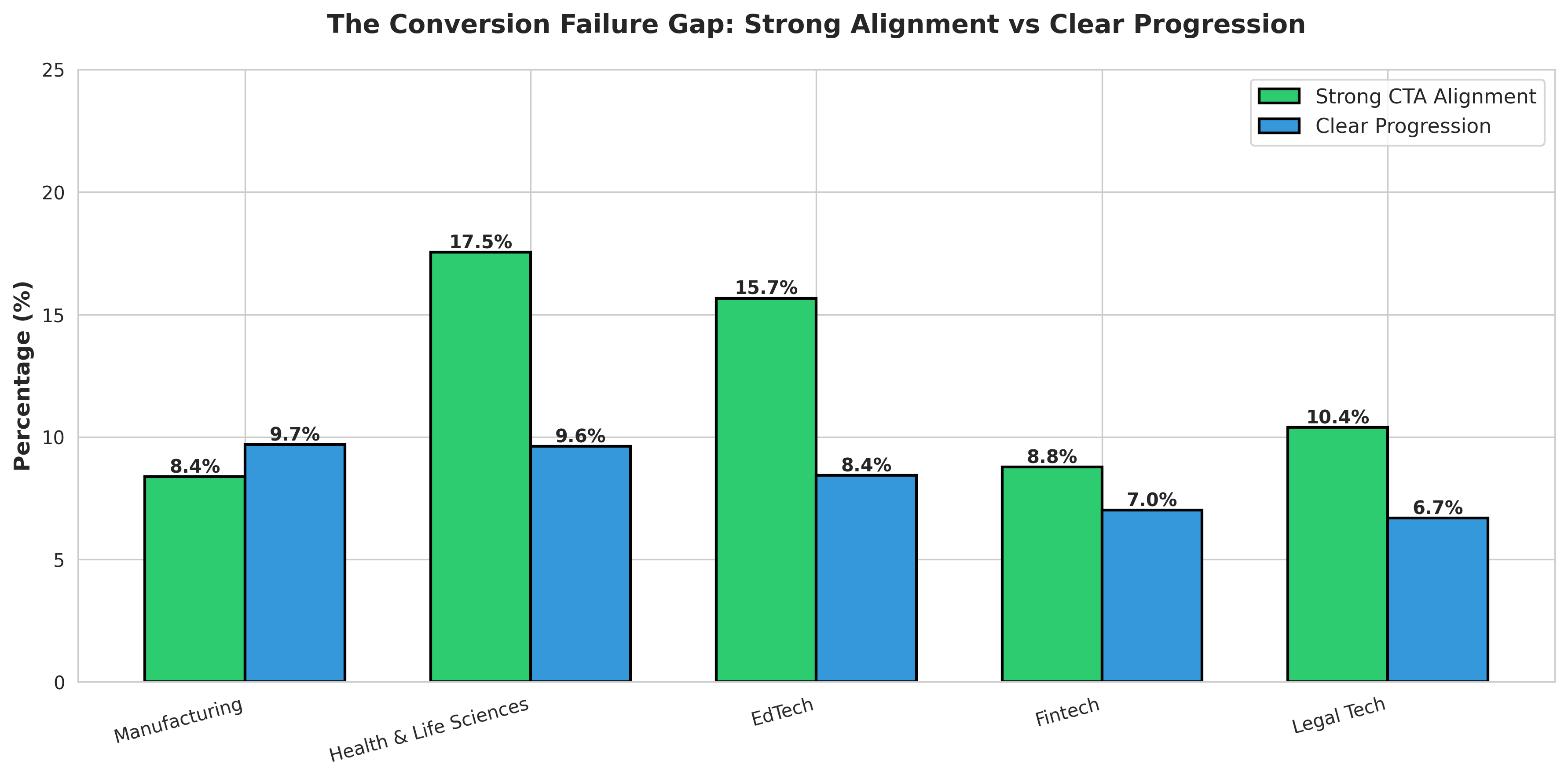
Chart 7: The Conversion Failure Gap — Side-by-side comparison of Strong CTA Alignment vs Clear Progression. This chart visually demonstrates our core finding: fewer than 1 in 10 companies achieve strong alignment, and fewer than 1 in 10 have clear progression paths.
Across 2,094 B2B SaaS companies we analysed in manufacturing, health and life sciences, fintech, legal tech, and EdTech, we found that fewer than 1 in 10 companies had both strong CTA-to-intent alignment and a clear progression path from blog content to conversion.
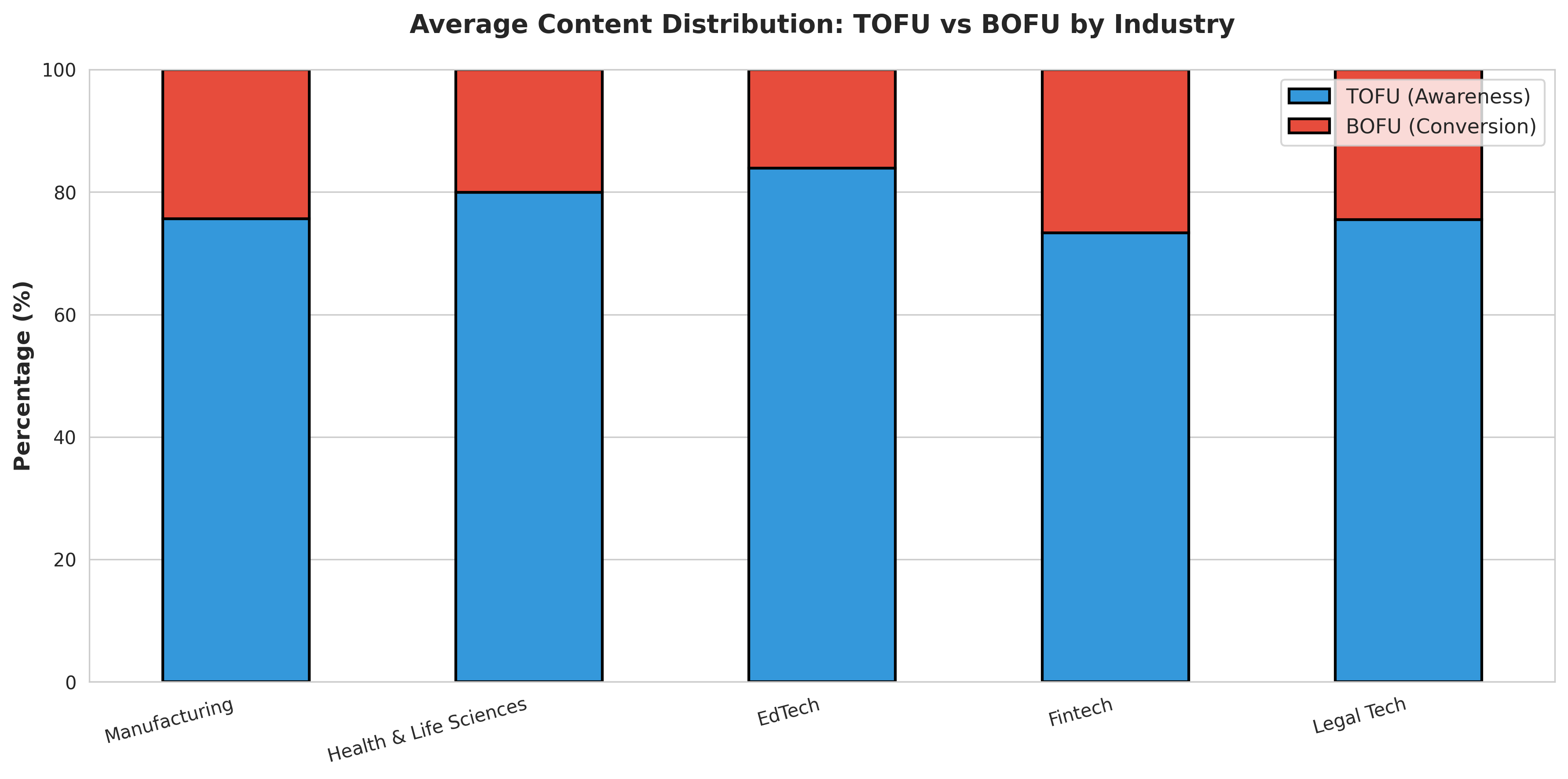
Chart 5: TOFU vs BOFU Distribution — Stacked bar showing the average content split between awareness (TOFU) and conversion (BOFU) content. EdTech is most TOFU-heavy at 83.9%, while Fintech is lowest at 73.3%
At the same time, every vertical was heavily top-of-funnel. Average TOFU share ranged from 73.3% in fintech to 83.9% in EdTech. In plain English, SaaS companies are publishing awareness content, then asking for bottom-of-funnel behaviour.
The core failure is simple
Most SaaS blogs attract readers at one stage of awareness, then present an offer built for a completely different stage. A visitor lands on an article because they want clarity, not because they are ready for procurement. Yet the standard next step is often a sticky “Request a demo” button, a generic footer CTA, or nothing at all. That is the TOFU-to-BOFU cliff, and it shows up across every sector in the dataset.
External research strengthens the same point. NetLine’s 2025 State of B2B Content Consumption report, built on 8 million first-party content registrations, found that demand for gated B2B content continues to rise, and that playbook registrations were 115% more likely to signal a buying decision within 12 months. The same report also found a 39-hour average gap between content registration and actual consumption, and it explicitly points to relevance, accessibility, timing, and follow-up quality as GTM factors that marketers can control. So even when a prospect raises a hand, the journey is not instant, and the content experience around the asset matters.
This is the mistake many SaaS teams make. They treat the blog as a traffic surface and the demo page as the conversion surface, with almost nothing in between. But B2B buyers do not move like that. They need intermediate proof, intermediate confidence, and intermediate actions.
Why your traffic does not convert
Your CTA asks for too much, too soon
This was the most consistent pattern in our research.
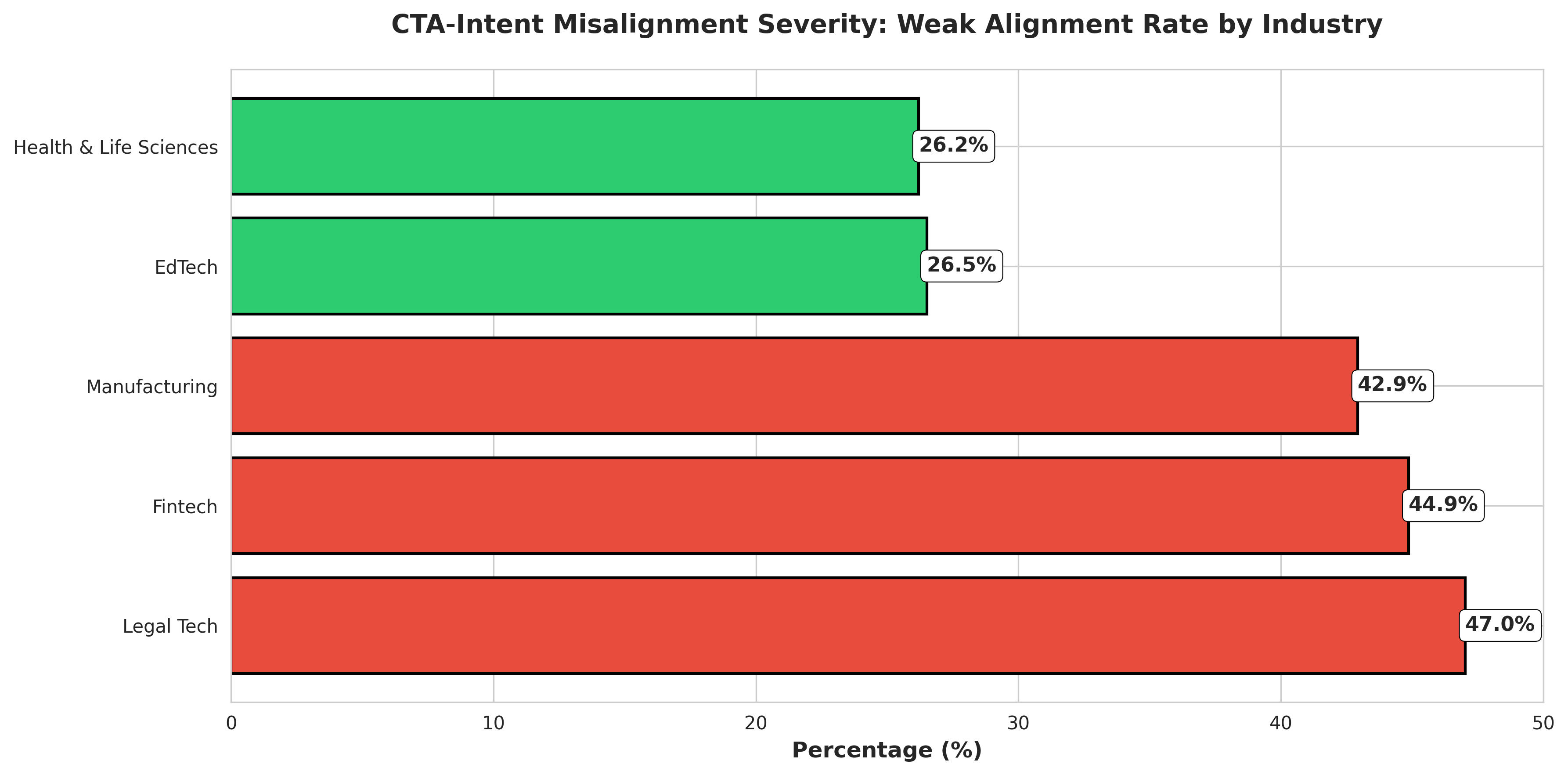
Chart 8: Weak Alignment Severity — Horizontal bar chart ranking industries by their weak CTA alignment rate. Legal Tech is worst at 47%, followed by Fintech at 44.9%, showing these industries have the most severe misalignment between content intent and CTA commitment.
Manufacturing SaaS was 75.7% TOFU on average, yet 85% of companies with blogs used the same high-commitment demo CTA across educational content.
Health and life sciences had the highest TOFU share at 79.9%, but only 9.6% showed a clear progression path.
Legal tech, the weakest category in the study, combined 75.5% TOFU with the highest weak-alignment rate and the lowest clear progression rate.
The pattern is not subtle. Educational content is paired with sales CTAs that belong much later in the journey.
You have mid-funnel assets, but you hide them
One of the most important original findings is what we would call the gated content deployment gap.
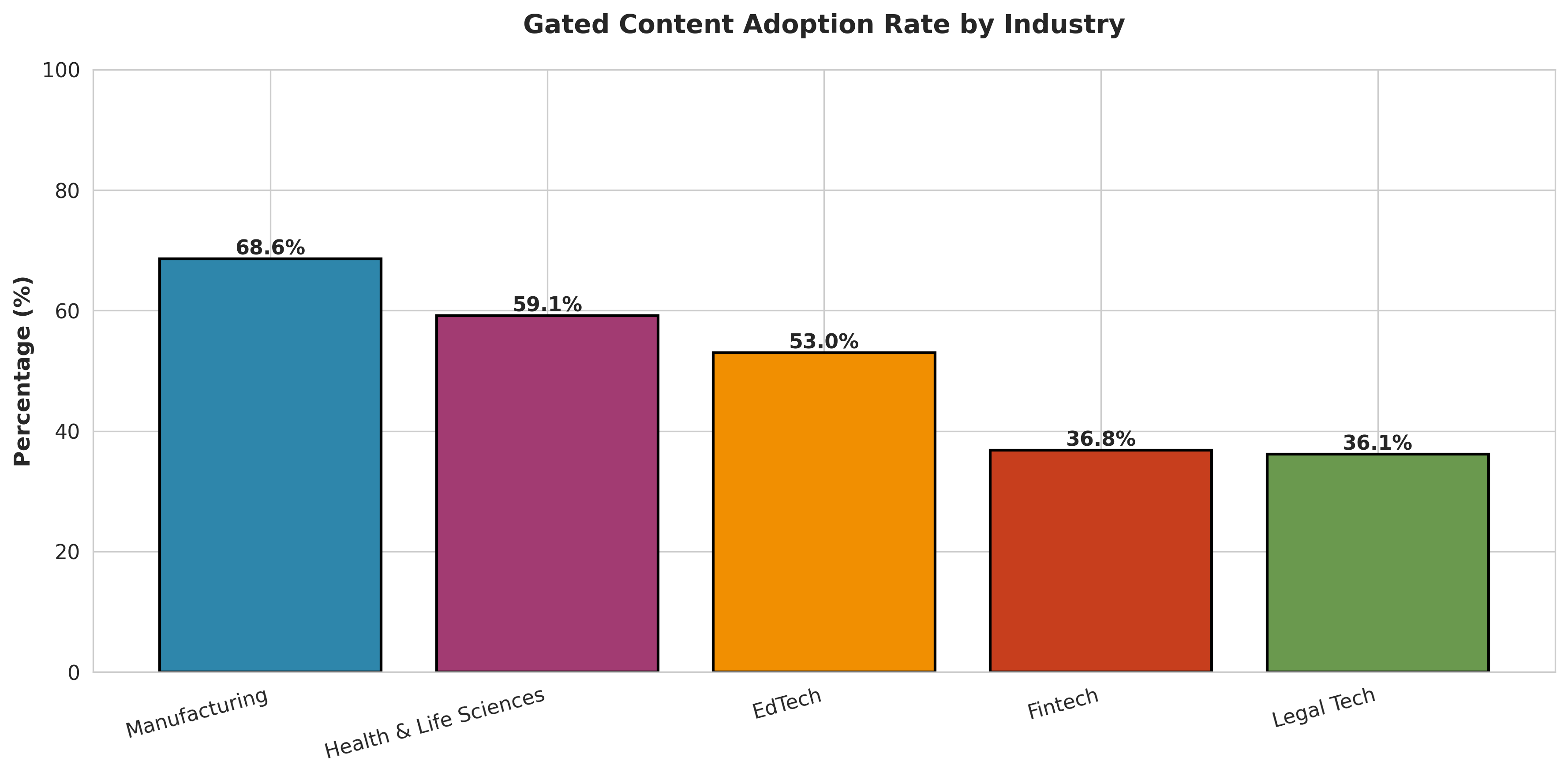
Chart 4: Gated Content Adoption — Shows the percentage of companies with blogs that use gated content (whitepapers, guides, webinars, etc.). Manufacturing leads at 68.6%, while Fintech and Legal Tech lag at 36.8% and 36.1%.
In every industry, companies had created whitepapers, guides, webinars, reports, or eBooks, but most of those assets lived in separate resource libraries rather than inside the blog posts already attracting traffic.
Manufacturing had the highest gated-content adoption at 68.6%, yet true inline promotion of relevant gated assets inside blog posts was rare. The asset existed, but not at the moment of intent.
That is a bigger mistake than it first appears. NetLine’s dataset suggests that format matters, and that playbooks, white papers, and webinars can signal meaningful purchase intent. If the traffic page never surfaces the right asset, you lose the chance to turn anonymous attention into a trackable mid-funnel relationship.
Your blog is a dead end, not a journey
Many SaaS blogs still behave like archives.
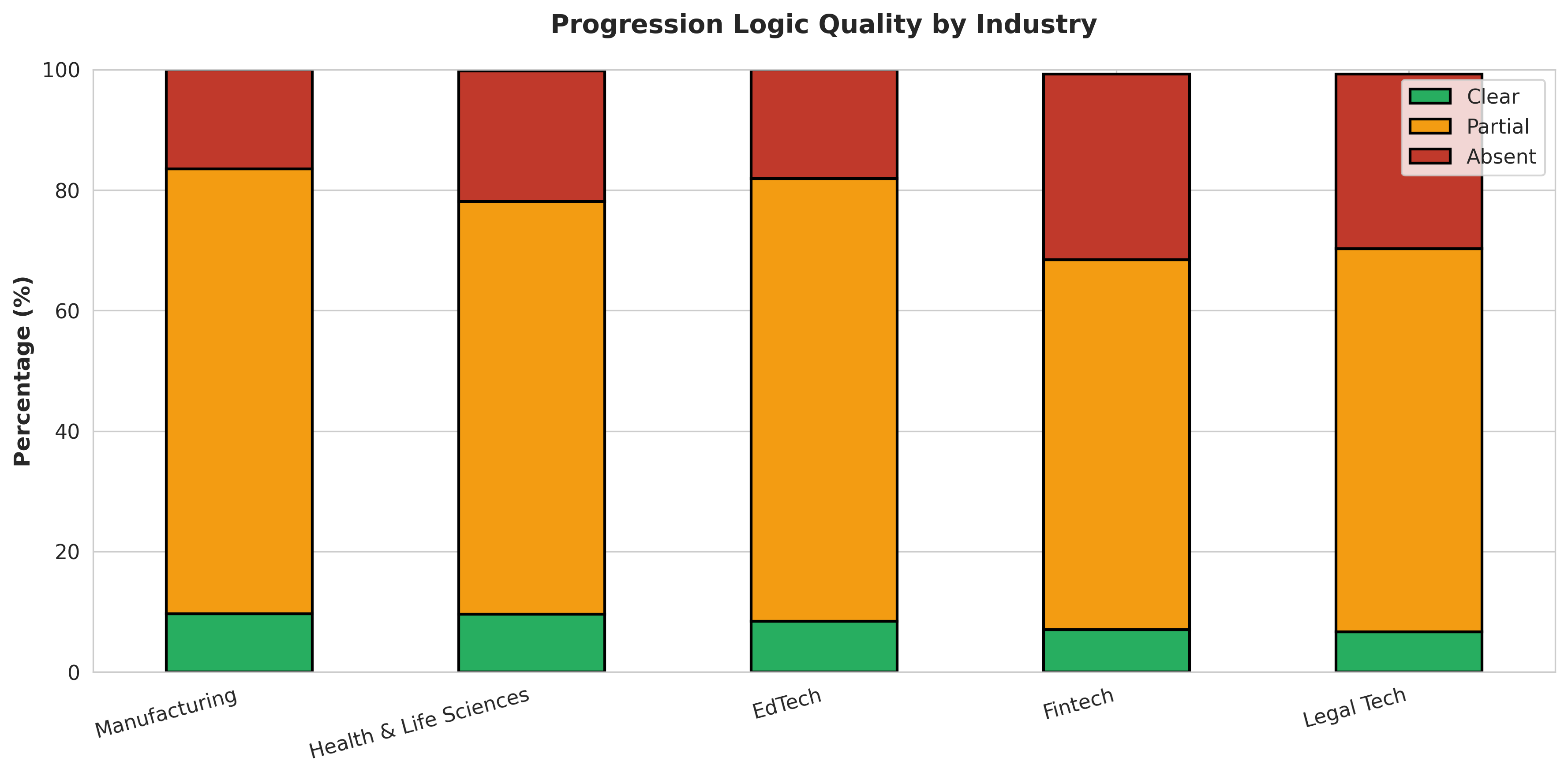
Chart 3: Progression Logic Quality — Stacked bar showing the distribution of Clear, Partial, and Absent progression paths. Across all industries, 60-74% have only partial progression, meaning no clear path from awareness content to conversion.
A user reads the article, reaches the bottom, and sees either a generic “Contact us” button, a newsletter form, or no meaningful next step at all.
In the dataset, clear progression logic was rare in every vertical, just 9.7% in manufacturing, 9.6% in health and life sciences, 8.4% in EdTech, 7.0% in fintech, and 6.7% in legal tech.
In other words, most companies are not failing because their CTAs are ugly. They are failing because they did not design the journey after the click.
Some companies are not really blogging at all
A surprising portion of “blogs” were effectively newsrooms, press release feeds, or announcement hubs.
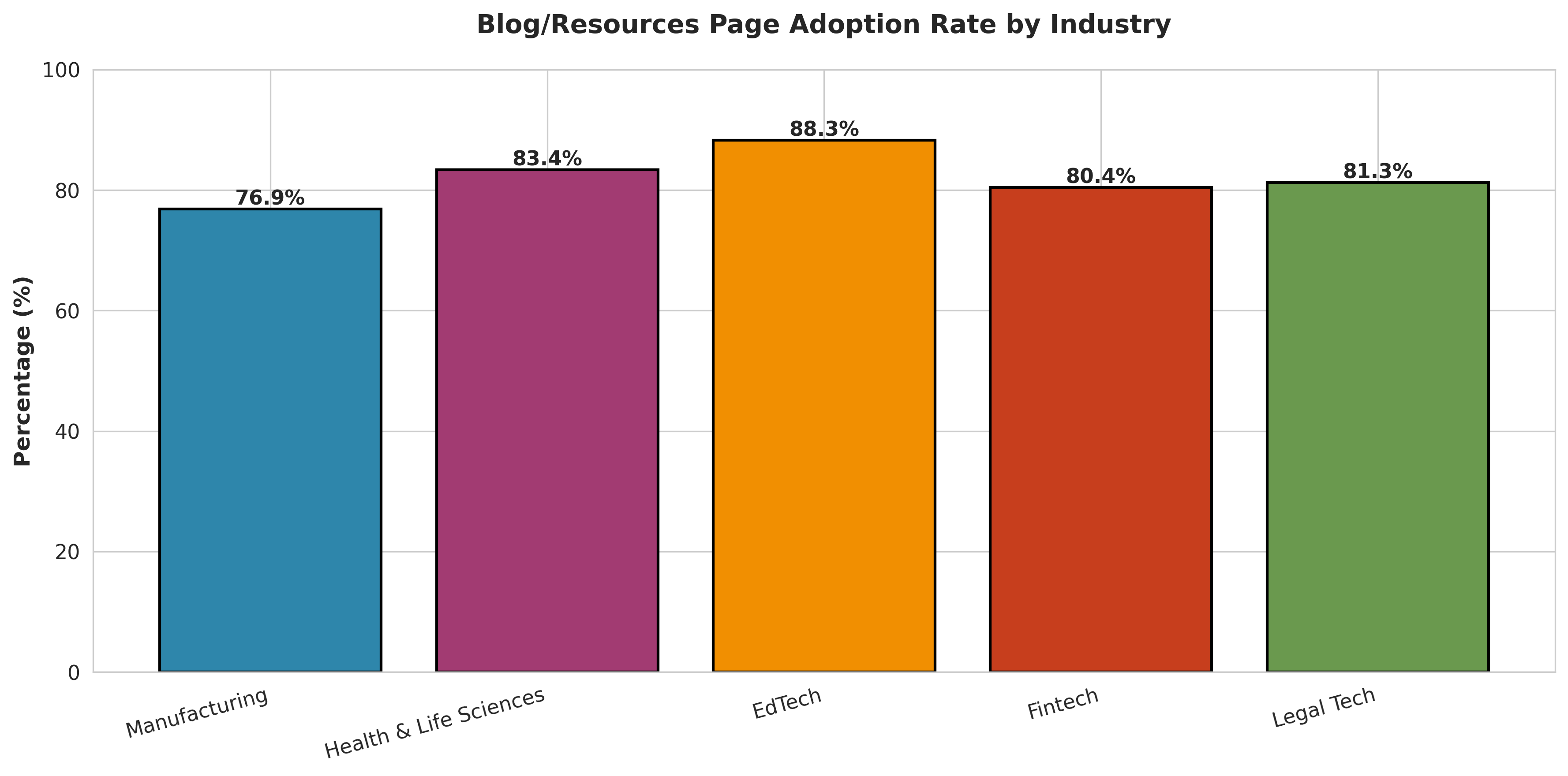
Chart 1: Blog Adoption Rates — Shows which industries have the highest percentage of companies operating a blog/resources page. EdTech leads at 88.3%, while all industries have strong adoption (76-88%).
That matters because a press release about a funding round is not the same thing as content that captures buyer demand.
This was especially visible in fintech and legal tech. Where the content hub is mostly company news, the conversion problem starts even earlier, the site is not generating the right traffic in the first place.
The failure looks different by industry, but the root cause is the same
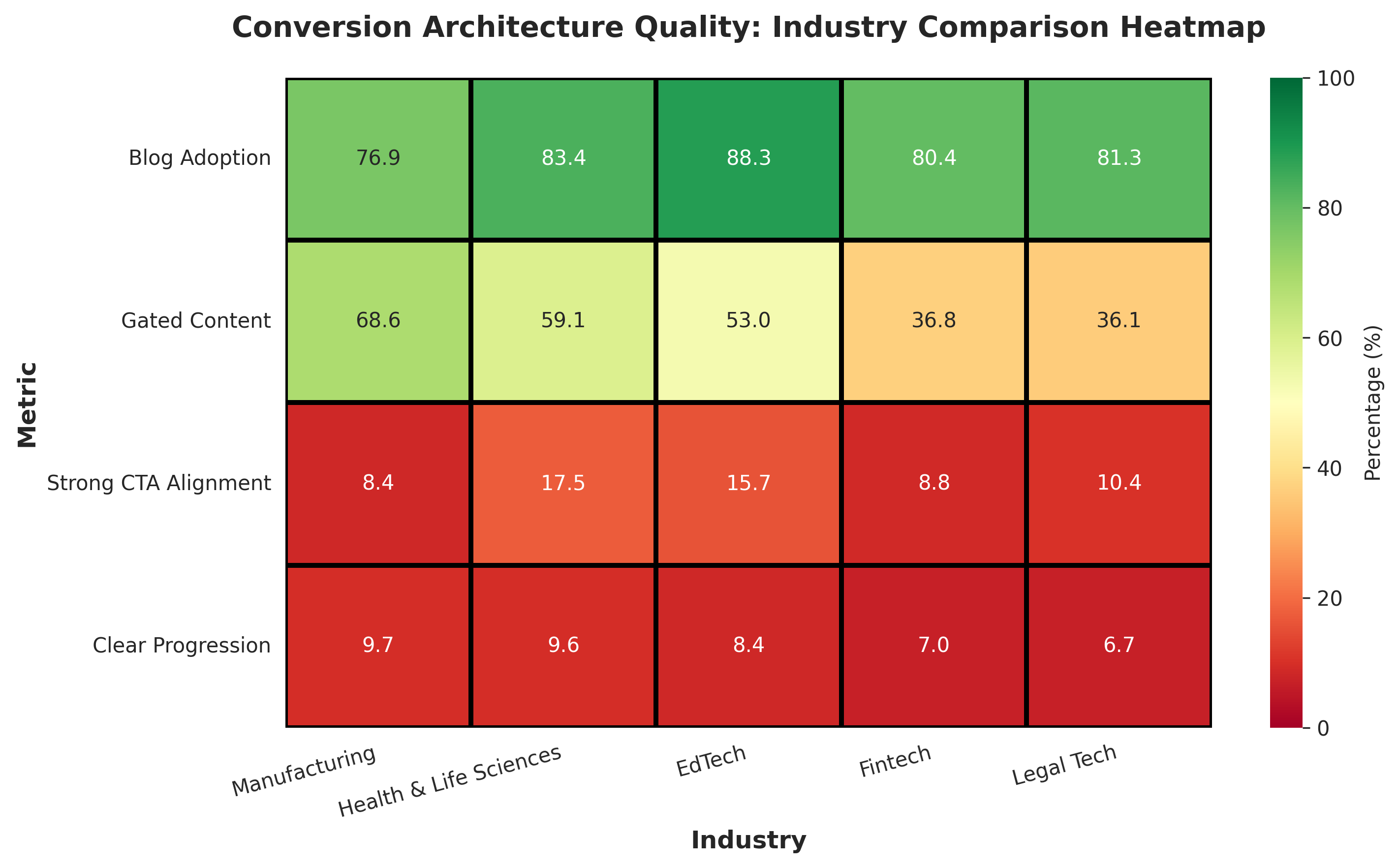
Chart 6: Comprehensive Heatmap — A color-coded matrix comparing all four key metrics across industries, making it easy to spot which industries have the most severe conversion architecture problems.
Manufacturing SaaS does not have a content volume problem. It has a deployment problem. The sector produces more gated assets than anyone else, but usually leaves them in disconnected resource centres while educational blog posts carry blunt demo asks. The result is a binary path, request a demo or leave.
Health and life sciences SaaS has a different flavour of the same issue. The blogs are more educational, trust-heavy, and thought-leadership oriented, which makes sense in a high-risk, multi-stakeholder category. But the conversion path is still weak. Many companies either rely on newsroom content that does not attract buyer intent, or they use educational content correctly at the top of the funnel and then fail to provide a credible mid-funnel step.
EdTech introduces another complication, audience confusion. Many EdTech companies serve both institutional buyers and end users, but their blogs do not segment the journey accordingly. The content attracts teachers, learners, administrators, and sometimes parents, while the CTA assumes one universal buyer. With 83.9% TOFU content on average, that mismatch becomes severe fast.
Fintech’s issue is sharper. It had relatively low gated-content adoption, heavy use of sales-first CTAs, and a meaningful amount of company-news-heavy content. For a quantitative, risk-sensitive buyer, this is a miss. Fintech buyers often need benchmark data, ROI models, compliance frameworks, and technical de-risking before they want a sales call. The architecture rarely reflects that.
Legal tech was the most broken category in the study. It had the lowest clear progression rate, the highest weak CTA alignment, and very low inline promotion of useful mid-funnel assets. That is especially costly because legal buyers are among the least tolerant of premature commercial pressure. If a legal operations leader or GC feels pushed into a demo too early, they do not convert later. They simply leave.
What high-converting SaaS content systems do instead
They stop treating every blog post as if it has the same job.
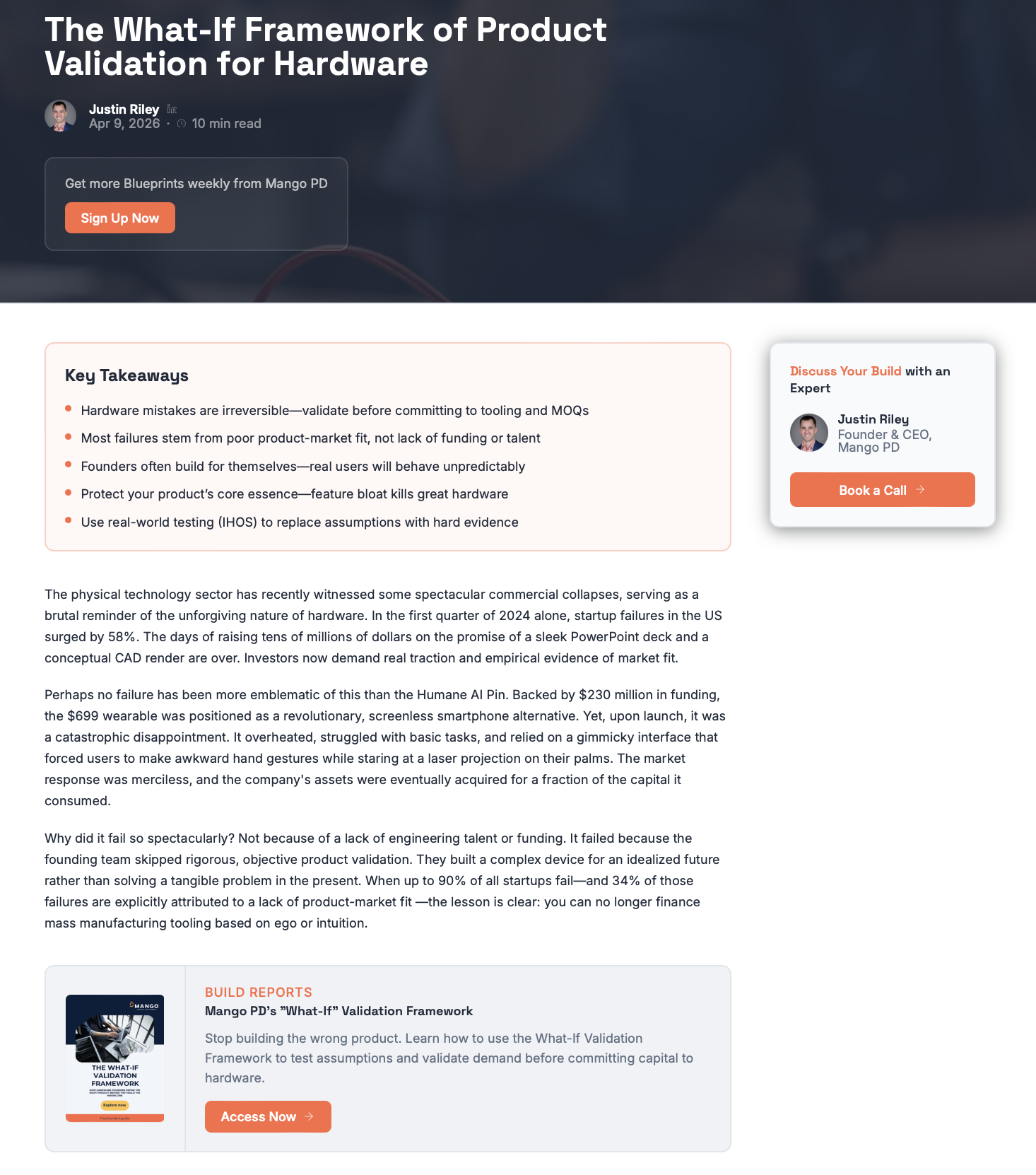
Example of a top-of-funnel educational page funnelling traffic to a downloadable resource with the goal of capturing early intent.
A top-of-funnel article should not usually ask for a demo (unless as a secondary CTA only). Its job is to earn attention from the right ICP, frame the problem well, and route the visitor to the next logical step.
That next step might be a benchmark report, implementation guide, template, webinar, calculator, or diagnostic.
A middle-of-funnel page should reduce risk and deepen specificity. That is where case studies, comparison content, ROI tools, and practical playbooks do the heavy lifting. Only when the reader is solution-aware and sufficiently convinced should the main ask become “Start free” or “Book a demo.”
They design the page around message match.
Unbounce’s 2024 benchmark report, based on 57 million conversions across 41,000 landing pages, found a 6.6% median conversion rate across industries and explicitly highlights message match between source and page as a core lever. That matters here because most blogs ignore it. The query, headline, article angle, CTA, and destination page often speak different languages. High-performing systems reduce that gap.
They understand that signups themselves have economics.
ChartMogul’s 2026 conversion report, based on 200 B2B software products, found that the median free-to-paid conversion rate was 8%, and that free-trial structure materially changes outcomes. The lesson is not that every SaaS business needs a free trial. The lesson is that the offer must fit the product, the friction level, and the buyer’s stage. Most blogs fail because they offer only the highest-friction action, regardless of context.
They also operate cross-functionally.
CMI’s 2025 B2B content research found that top performers are more likely to have effective strategy, the right technology, scalable content creation models, and stronger alignment across teams. Less successful teams explicitly cited silos, weak targeting by buyer stage, and lack of coordination. That maps almost perfectly to the problem we see in the SaaS blog landscape, content is being produced, but not orchestrated as a revenue system.
What SaaS teams should do next
First, stop judging the blog as one undifferentiated channel. Split content by job.
Some pages exist to capture search demand. Some exist to qualify. Some exist to nurture. Some exist to enable sales.
Once you do that, the conversion expectation becomes more realistic and more commercial.
Second, map every high-traffic post to a stage-appropriate next step.
If an article is early-stage, offer a guide, benchmark, checklist, webinar, or mini-tool.
If it is middle-stage, offer a case study, comparison page, implementation asset, or ROI calculator.
If it is late-stage, then ask for the demo or the trial. The CTA should match the user’s current question, not your quarterly pipeline target.
Third, deploy assets inline, not only in the resource hub.
Our data shows that many SaaS companies already have usable gated content. They simply fail to place it where intent is happening. This is one of the fastest fixes available because it is often an architecture problem, not a content production problem.
Fourth, build progression deliberately.
Every strong article should answer, “What should this reader do next if they are interested but not ready?” If there is no good answer, the page is not commercially finished. NetLine’s research is a useful reminder here, engagement depends on relevance, accessibility, timing, and follow-up, not just on whether the form exists.
Fifth, stop thinking “blog” and start thinking “resource hub,” “learning centre,” “playbook library,” or “content product.”
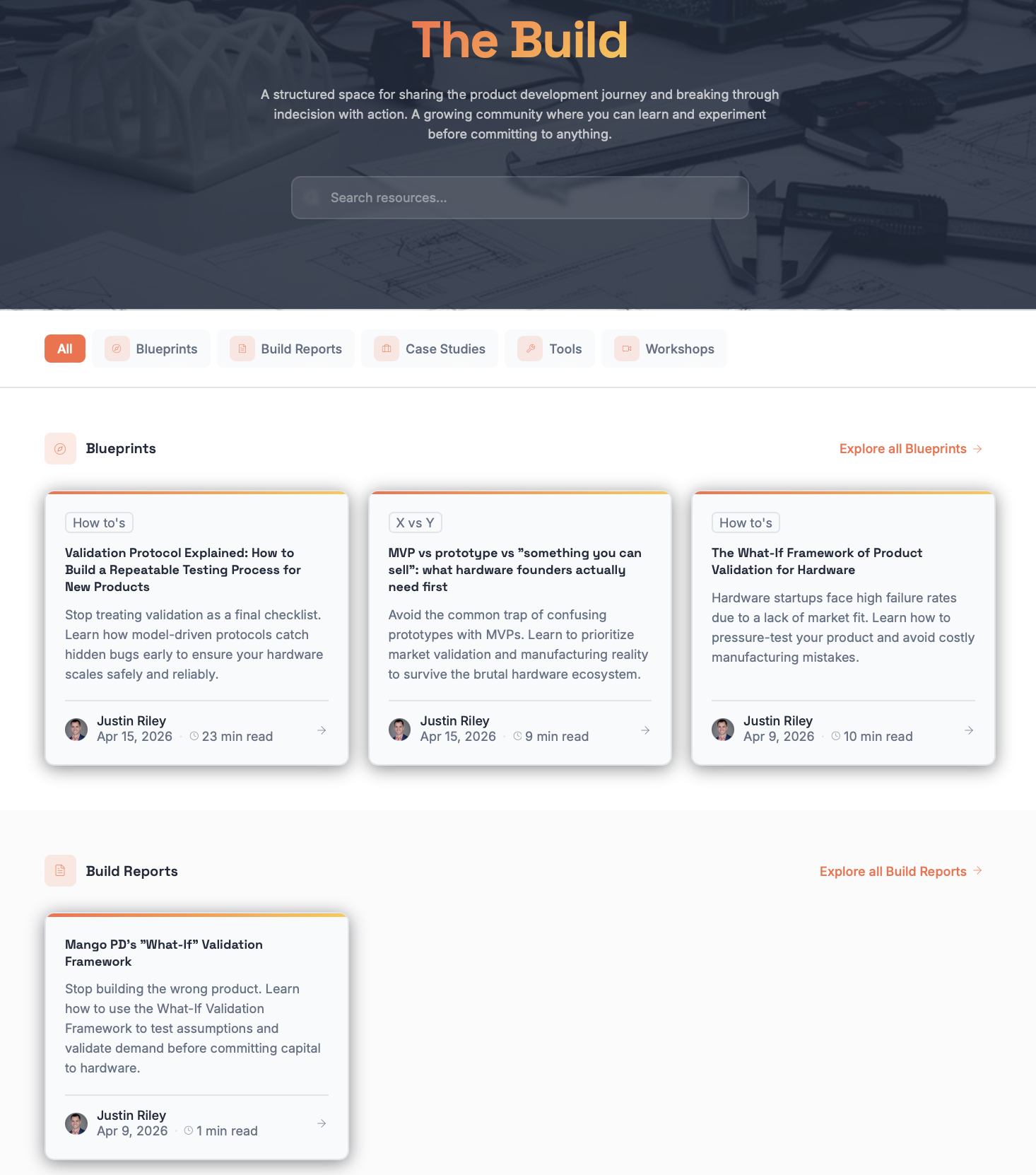
Example of a content product "The Build" tailored to appeal to consumer electronics founders embarking on their latest "Build".
That is the real shift. A blog is a publishing format. A resource hub is a go-to-market asset. One chases visits. The other shortens time-to-value, improves lead capture, supports nurture, and gives sales something useful to work with. That is the whole Content RevOps argument, and it is also what your best case studies already prove.
The real answer
SaaS blogs get traffic but fail to generate signups or demos because most of them were never designed to convert the way B2B buyers actually buy. They attract early-stage attention, then present late-stage asks. They produce gated assets, then hide them away. They publish articles, then give the reader no logical progression. They measure traffic, not movement. They treat content as output, not as part of the revenue system.
The companies that win do something simpler, but much harder. They build content like infrastructure. They match the asset to the buying stage. They use content to educate, qualify, de-risk, and nurture, not just to rank. In other words, they stop asking the blog to magically create demos, and start designing a content journey that earns them.
Why your blog isn’t converting and how to fix it
We’ll show you exactly where your content loses buyers and how to turn it into a predictable pipeline system.
Frequently Asked Questions
About the Author

Founder & CEO, Content RevOps
Stefan Kalpachev is the founder and CEO of Content RevOps, where he helps B2B SaaS companies transform their content into predictable pipeline. With a background in content marketing and revenue operations, Stefan has developed a unique methodology that bridges the gap between content creation and revenue generation.
Connect on LinkedIn