How the Demand Generation Funnel Works — by the Numbers
Want a funnel that's measured at every joint—not just at the top? See exactly where yours leaks.
Book a CallEvery guide to the demand generation funnel draws the same tidy triangle: awareness at the top, a demo request at the bottom, a few neat arrows in between. Then, somewhere in the same article, the author admits the buyer journey "isn't really linear anymore." Both things can't be the load-bearing idea. Either the funnel is a map of how buyers move, or it isn't.
It isn't — and that's fine. The funnel was never a description of buyer behaviour. It's a model you impose on a messy process so you can instrument it, spot where it leaks, and decide where the next dollar goes. The useful question isn't "what are the stages." It's "what happens to a real cohort of people as they pass through each joint, and how much does each joint cost you?" That question has answers, and the 2025–26 benchmark data answers it bluntly: the funnel leaks at every stage, win rates are falling, and the biggest losses happen in places most teams never instrument.
This is the funnel with the real numbers attached.
What a demand generation funnel actually is
A demand generation funnel is the staged model a marketing team uses to turn broad, unaware demand into a sales-ready opportunity — and, crucially, to measure movement between each stage so the system can be managed instead of guessed at.
In our own work we keep it to four stages, because more than that and nobody can hold the model in their head:
- Aware — they come across you for the first time, through search, social, outreach, or paid. They may only see the content; they don't need to click yet.
- Interested — they engage more directly: visit a page, explore the hub, spend real time on a piece.
- Engaged — they opt in. A download, a newsletter sign-up, an event registration. Attention or data is exchanged for value.
- MQL — they show clear commercial intent: a demo request, a quote, a contact form, or a behaviour-and-fit handover sales actually wants.
The names matter less than the discipline. The point of drawing the funnel before you produce anything is that it tells each asset what job it has to do, and it tells you what to measure at each handoff.
But here's the part the triangle hides. Buyers do not file through those stages in order. Gartner's research describes B2B buying as "looping" — prospects revisit the same "buying jobs" again and again, in no fixed sequence, doing most of the work without you in the room. By the time a buyer talks to a vendor, 94% of buying groups have already ranked a preferred supplier, according to 6sense's 2025 Buyer Experience Report — and that Day-One favourite goes on to win the deal most of the time. Forrester counts 13 people in the average buying decision, and a single 11-person buying group throws off 150–200 digital touchpoints per vendor before anyone fills in a form.
So the funnel isn't the buyer's path. It's your measurement layer over a process that's mostly invisible. Every benchmark below should be read in that light: these are conversion rates of the slice you can see, which is exactly why instrumenting the joints is the whole game.
The funnel by the numbers
Start with the shape of the thing. Here is what a cohort actually does as it moves down, using First Page Sage's B2B SaaS funnel benchmarks (their dataset skews to $10M–$100M SaaS, SEO-heavy — caveat it, but it's the most granular stage-by-stage data published).
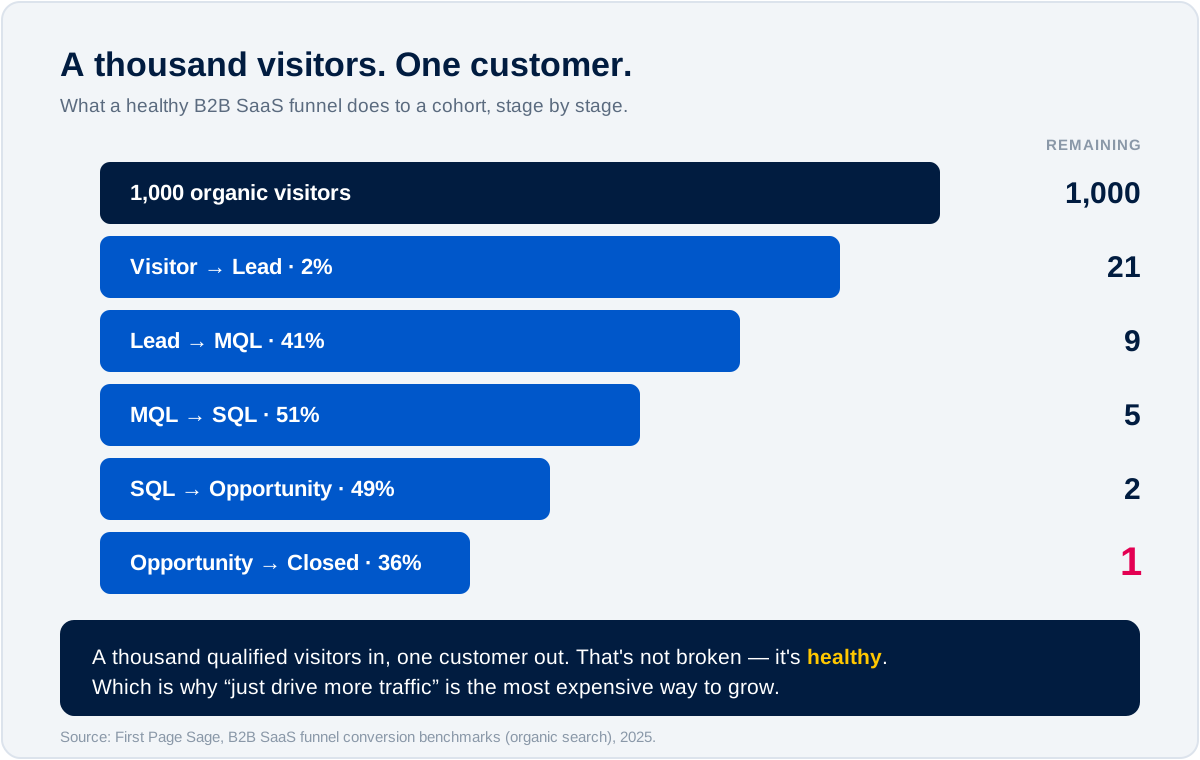
Take 1,000 visitors arriving from organic search:
- Visitor → Lead: ~2%. You're down to about 21 people. Most of your audience never identifies itself, and that's normal — visitor-to-lead sits between roughly 2% and 3.6% across B2B depending on how you count.
- Lead → MQL: ~41%. About 9 leads clear the marketing-qualified bar.
- MQL → SQL: ~51%. Roughly 4–5 become sales-accepted.
- SQL → Opportunity: ~49%. Around 2 turn into real pipeline.
- Opportunity → Closed: ~36%. Most of one deal.
A thousand qualified visitors, one customer. That's not a broken funnel — that's a healthy one. And it explains why "just drive more traffic" is such an expensive way to grow: you're paying for the top of a column that loses 99.9% of its volume by the bottom.
One warning that matters more than any single number here: a benchmark is only as meaningful as the stage definition behind it. Measured loosely, B2B SaaS shows ~36% opportunity-to-close. Measured strictly — from a sales-accepted SQL with budget and a booked meeting — close rates for B2B SaaS sit around 12%. Same category, wildly different number, because the word "SQL" means different things in different CRMs. Before you compare yourself to anyone, write down exactly what each stage means and what behaviour moves someone into it. If your MQL definition is vague, every conversion rate downstream is noise.
The MQL→SQL joint is where channels go to die
Average conversion rates hide the most important fact about a funnel: the channel that filled the top decides what happens at the bottom. Two leads can sit in the same MQL stage and have completely different odds of becoming pipeline, purely because of where they came from.
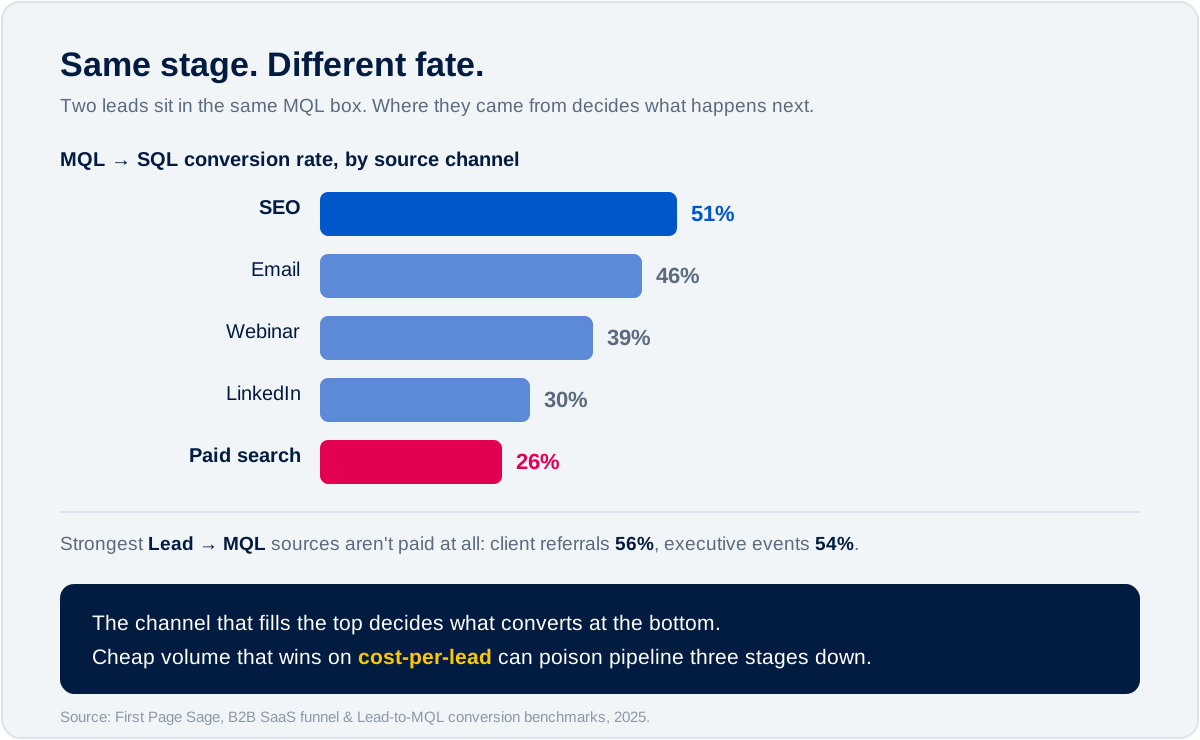
The First Page Sage data makes this vivid at the MQL→SQL handoff:
- A lead from SEO converts MQL→SQL at about 51%.
- A lead from paid search converts at about 26% — half as well.
Same stage, same label, double the drop-off. The same pattern shows up at the very top: the highest Lead→MQL rates don't come from any paid channel at all but from client referrals (~56%) and executive events (~54%), while webinars and broad PPC sit far lower on a per-lead basis.
The practical lesson cuts against how most demand teams are measured. A cheap channel that floods the top of the funnel with low-intent volume can look like a winner on cost-per-lead and quietly poison your pipeline three stages later. This is the entire case for quality over quantity as an operating principle rather than a slogan: a smaller number of better-sourced leads will out-convert a larger number of cheap ones so decisively that the "expensive" channel is usually cheaper per closed deal. Which is exactly why you have to follow the cohort all the way down — and cost it — before you call anything efficient.
Where the funnel actually leaks
Ask a team where their funnel leaks and they'll point at the conversion rate that looks lowest. The real leaks are sneakier than that, and the deal-level data exposes them.
Ebsta and Pavilion's GTM benchmarks, built on hundreds of thousands of opportunities, found that win rates fell roughly 10% year over year heading into 2025 — the funnel is getting harder, not easier. But the more useful findings are about motion:
- 44% of deals slip their expected close date. When a late-stage deal slips beyond two months, win rates collapse.
- 29% of opportunities skip a stage in the CRM — and a deal that skips a stage is 46% less likely to close. Stage-skipping usually means a rep is papering over a gap (no real champion, no confirmed budget) that surfaces later as a loss.
- Velocity is a leading indicator of death. When a deal sits in the qualification stage 50% longer than average, it becomes dramatically more likely to slip. Time-in-stage tells you a deal is dying long before the forecast does.
Zoom out from the individual deal and the picture is worse. Forrester reports that 86% of B2B purchases stall somewhere in the process, and a large share of "lost" deals aren't lost to a competitor at all — they're lost to no decision, the buying group failing to reach internal consensus. That's the leak no amount of top-of-funnel volume fixes. If 86% of deals are stalling, pouring more leads in the top just means more deals to stall.
None of these leaks show up on a standard funnel chart, because a funnel chart only counts whether people moved, not how or how fast. Instrument time-in-stage, stage-skipping, and slip rate, and you'll find the holes the conversion percentages hide.
Get a FREE Content RevOps Audit
Discover exactly where your content-to-pipeline gaps are and get a personalized action plan to fix them.
Speed-to-lead: the most fixable leak in the whole funnel
Here is the leak with the best return on attention, because it's almost entirely within your control and almost everyone is bad at it.
The original study is nearly twenty years old and still describes the cliff perfectly. Research later written up in Harvard Business Review found that contacting a web lead within five minutes versus thirty made you 100 times likelier to connect and 21 times likelier to qualify them. The buyer's window of attention is brutally short, and it closes fast.
Two decades later, almost nobody acts on it. A 2026 analysis of 939 B2B SaaS companies found the average lead response time is 47 hours. Only 23% respond within five minutes; 42% take more than a day. And the conversion gap maps exactly to the speed: leads worked in under five minutes closed at 32%, versus 12% for those contacted after 24 hours. Nearly a 3x swing, available to anyone willing to fix their routing.
The mechanism compounds at the form, too. Chili Piper's analysis of ~4 million demo forms found that letting a qualified prospect book a meeting instantly after the form — instead of waiting for a rep to chase them — roughly doubled inbound conversion, from an industry-typical 30% to about 67%. And the follow-up discipline behind the average team is dismal: roughly half of reps never make a second attempt, and most give up well before the fifth touch, even though hand-raisers routinely need several.
This is the cheapest pipeline you will ever find. You've already paid to generate the lead; the only thing standing between you and a 2–3x lift is the operational plumbing — routing, instant scheduling, an SLA on response time, and the discipline to actually follow up. Fix the handoff before you spend another cent at the top.
What each stage actually costs
A funnel chart shows conversion. It hides cost — which is why teams keep "optimising" toward channels that convert nicely and bleed money. Put a price on each path and the rankings flip.
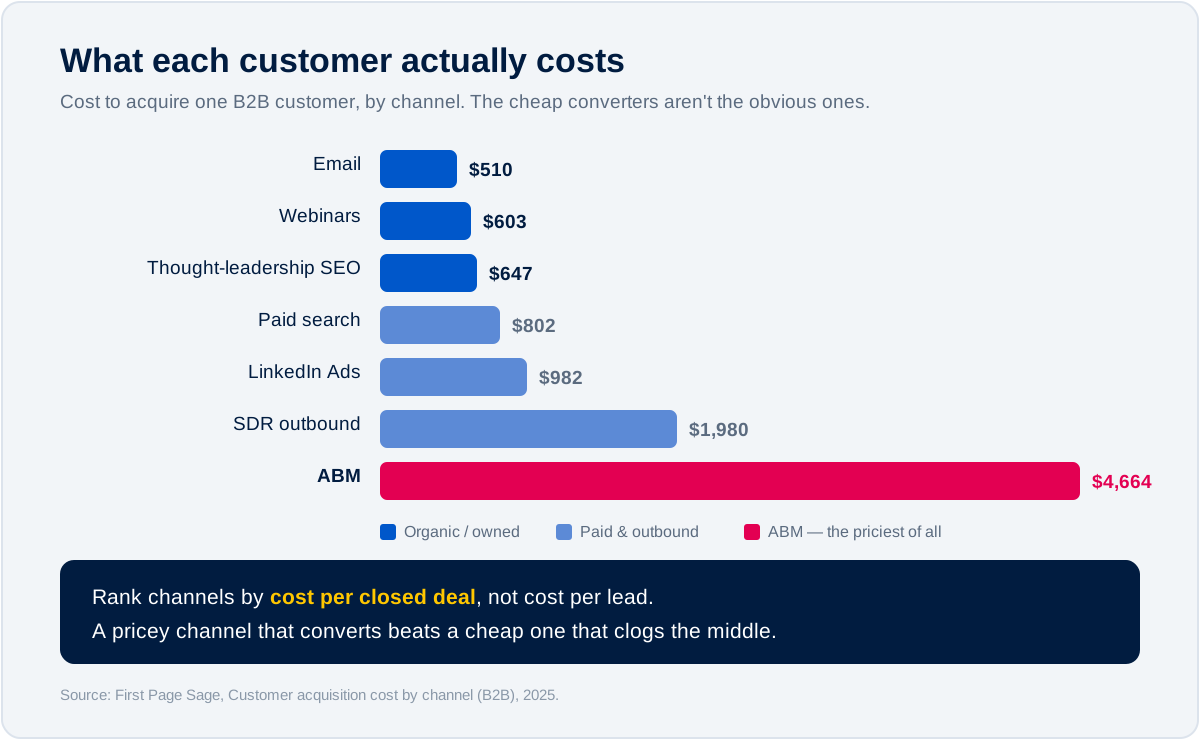
First Page Sage's customer-acquisition-cost-by-channel data is the cleanest read on this. The spread between channels is enormous:
- Webinars (~$603) and email (~$510) are among the cheapest ways to acquire a B2B customer.
- Thought-leadership SEO (~$647) sits right behind them.
- Paid search (~$802) and LinkedIn Ads (~$982) cost meaningfully more.
- SDR-driven outbound (~$1,980) is expensive.
- Account-based marketing (~$4,664) is the priciest of all — which doesn't make it wrong, but does mean it has to be aimed at accounts whose deal size can absorb it.
Cost-per-lead tells the same story earlier in the funnel: B2B SaaS leads run about $310 from paid versus $164 from organic. And the macro picture is tightening — Benchmarkit's 2025 SaaS data puts the median cost to acquire a dollar of new ARR at $2.00, while a dollar of expansion ARR costs just $1.00. Existing customers are the most efficient pipeline in your funnel, and most demand programs ignore them entirely.
Read those two facts together — the per-channel CAC and the cohort math from earlier — and the real efficiency metric stops being cost-per-lead and becomes cost per closed deal, by source. A channel with a high CPL and a high MQL→SQL rate routinely beats a cheap channel that clogs the middle. You can only see that if you've costed the whole column, not just the top.
The content that moves buyers (and the volume trap)
Inside those stages, content does the actual work of moving people — and here the data busts a comfortable assumption. More consumption does not mean more intent.
NetLine's 2025 content consumption report, drawn from 8 million first-party registrations, found that eBooks account for more than half of all content demand — yet they're about 12% less likely than average to signal a purchase within a year. They're the most-downloaded format and one of the weakest buying signals. Meanwhile, formats almost nobody over-produces — playbooks, guides, on-demand webinars — correlate with far higher near-term purchase intent (playbooks score over 100% above the baseline). The same report clocks a widening "consumption gap": buyers now wait an average of 39 hours between registering for something and actually opening it. The lead is real; the urgency usually isn't.
Webinars remain one of the few formats that earn genuine engaged time. ON24's 2025 benchmarks put registration-to-attendance at about 57%, with the average attendee staying roughly 50 minutes — an eternity of attention by digital standards, and the reason webinars punch above their cost in the funnel.
The operating takeaway is the house rule again: every asset has a job. Stop counting downloads as wins. Match the format to the stage — utility and proof where you need intent, not another gated PDF that pads the lead count and stalls in the middle.
Why the funnel is getting harder — and what teams are changing
Step back and the macro data confirms what the deal-level numbers imply: the funnel is under more pressure than it's been in years, and the measurement that's supposed to manage it is broken.
Budgets aren't riding to the rescue. Gartner's 2025 CMO Spend Survey found marketing budgets flatlined at 7.7% of company revenue, with most CMOs saying they don't have enough to execute their strategy. Win rates are down, cycles are stalling, and there's no extra money to brute-force it. The only lever left is a tighter funnel.
The metrics are quietly shifting in response. In the 2025 Demand Generation Benchmark Survey, the single most-cited demand-gen metric is now "opportunities generated" (52%), edging ahead of MQLs and SALs (47%) — teams are inching toward the bottom of the funnel for their definition of success.
But "inching" is the word. 6sense's 2025 study of B2B marketing metrics is blunt about the gap between what teams say and what they do: only 29% of account-based teams are measured solely on account-aligned metrics, roughly half still lean on MQLs, and just 13% report closed-won revenue to the board — outcome metrics are still treated as "sales' job." And the attribution underneath is thinner than the dashboards suggest: multi-touch models typically credit three or four visible touchpoints out of the 150–200 a buying group actually generates. Most of the funnel is dark, and the standard report quietly pretends it isn't.
That's the reckoning. The funnel is getting harder to convert and harder to see, at the same time. The teams pulling ahead aren't the ones with the most leads — they're the ones measuring movement and pipeline instead of volume, and treating self-reported "how did you hear about us" data as a serious input rather than a soft one.
How to build a funnel that doesn't leak
None of this argues for throwing the funnel out. It argues for building it deliberately and instrumenting the joints. A practical sequence:
Define MQL before you make anything. Write down which roles qualify, what behaviour counts as intent, what fit criteria matter, and what context sales needs at handover. If that definition is vague, every number downstream is meaningless. This is the single highest-leverage hour in the whole build.
Build a working funnel table, not just a triangle. For each stage, define the tactics that move people forward, the audience sitting in it, what you measure, the expected conversion to the next stage, the cost to run it, and the volume you expect. Rough estimates are fine to start — the point is that the model is explicit and you can compare reality against it.
Instrument the joints, not just the stages. Track time-in-stage, stage-skipping, and slip rate, because that's where the real leaks hide. A deal lingering in qualification is dying; catch it there, not in the forecast.
Fix the handoff before the top. Put an SLA on lead response, add instant scheduling for hand-raisers, and enforce a real follow-up cadence. It's the cheapest conversion lift available and almost everyone leaves it on the table.
Pick channels by cost-per-opportunity, not cost-per-lead. Cost the whole cohort down to closed-won by source. Cheap leads that don't convert are the most expensive thing in the funnel.
Keep a coverage buffer and prune honestly. Most B2B teams aim for 3x–5x pipeline-to-quota to absorb the deals that won't close, and clean out stalled deals rather than letting them flatter the forecast.
Do that and the funnel stops being a diagram you redraw for the deck and starts being what it was always meant to be: an operating model that tells you, joint by joint, where the money is leaking and what to fix next. Done well enough, the buyer never feels the funnel at all — they just feel guided. The plumbing is for you.
Is your demand gen funnel built to move pipeline—or just count leads?
Get a Content RevOps audit: stage-by-stage conversion, the leak points your dashboard hides, and a funnel wired to revenue—not MQL volume.
Frequently Asked Questions
About the Author

Founder & CEO, Content RevOps
Stefan Kalpachev is the founder and CEO of Content RevOps, where he helps B2B SaaS companies transform their content into predictable pipeline. With a background in content marketing and revenue operations, Stefan has developed a unique methodology that bridges the gap between content creation and revenue generation.
Connect on LinkedInRelated Articles
Demand Generation for SaaS: Top 10 Strategies
Jun 11, 2026
Demand Generation Manager: What 1,000 Job Postings Reveal About the Role, Pay & Skills (2026)
Jun 10, 2026
The Demand Generation Framework Most Teams Build Backwards
Jun 9, 2026