Demand Generation Manager: What 1,000 Job Postings Reveal About the Role, Pay & Skills (2026)
Hiring a demand generation manager — or trying to become one? We help B2B teams build the pipeline engine the role is actually measured on.
Book a CallAsk a room of B2B marketers what a demand generation manager actually is and you'll get a fight. "It's just lead gen," one r/marketing commenter shrugs. "It's just a fancy rebrand for the most part," says another — "like 'chief customer officer' is a rebrand of 'chief marketing officer.'" A third, five years into the role, describes it as touching "a bit of everything marketing — ad copywriting, marketing ops, SEO, paid ads, marketing analytics, and yes a bit of project management as well."
They're all describing the same job, and they're all a little bit right, which is exactly the problem. So instead of adding one more tidy definition to a search results page already full of them, we did something the other articles didn't: we pulled 1,000 live "demand generation manager" job postings from LinkedIn in 2026 and read what employers are actually asking for — the titles, the pay, the tools, the experience bar, and how many people are fighting for each opening.
The first thing the data showed us reframes everything else. Of those 1,000 postings, only 152 were actually titled "Demand Generation Manager." The role you're searching for mostly exists under a different name.
What a demand generation manager actually does in 2026
Start with the textbook version, because it's worth knowing how far the real job sits from it.
In theory, demand generation is the function focused on generating demand by building brand awareness and creating interest long before anyone is ready to buy, while lead generation captures contact information from interested prospects. There's a hard number underneath this. At any given moment only about one in twenty B2B buyers is actually in the market for what you sell. The Ehrenberg-Bass Institute and Professor John Dawes fixed a figure to it — the 95:5 rule — and the implication is that ninety-five percent of your future customers can't be converted today no matter how good the campaign, because they don't have the need yet. On paper, the demand gen manager's job is to reach that ninety-five percent before they enter the sales funnel.
Now read what the people doing the job actually say. "Everything I do is really about increasing form fills," an enterprise-software demand gen manager explains. "Due to the long sales cycle, high price point, etc., everything I do is really about increasing form fills that meet specific organizational criteria." Another describes the day as orchestration: "figuring out the best way to hit those goals which is typically through a variety of tactics — ads, webinars, content, events." The metric that hangs over all of it is pipeline. In our dataset, 40% of postings name pipeline explicitly, and the responsibilities cluster around capturing and converting demand that already exists — paid media, nurture, lifecycle, MQLs — far more than creating it.
That's the honest shape of the role: a function sold on the language of demand creation but measured, in practice, on demand capture. The best operators refuse to let that box them in. "A trap junior demand gen marketers often fall into is letting other teams pigeonhole them into just campaign managers," one team lead warns. "Demand gen should have its fingers in everything from first awareness touch to the final sale." The job description will say "own the funnel." Whether you actually do depends on how hard you push — and on which version of the role you were hired into, because there are many.
The title problem: only 15% of demand generation manager jobs say "demand generation manager"
Here's the finding that should change how you search. Across 1,000 postings returned for "demand generation manager," fewer than one in six — 152 of them — carried that exact title. The rest were hiding in plain sight under other names.
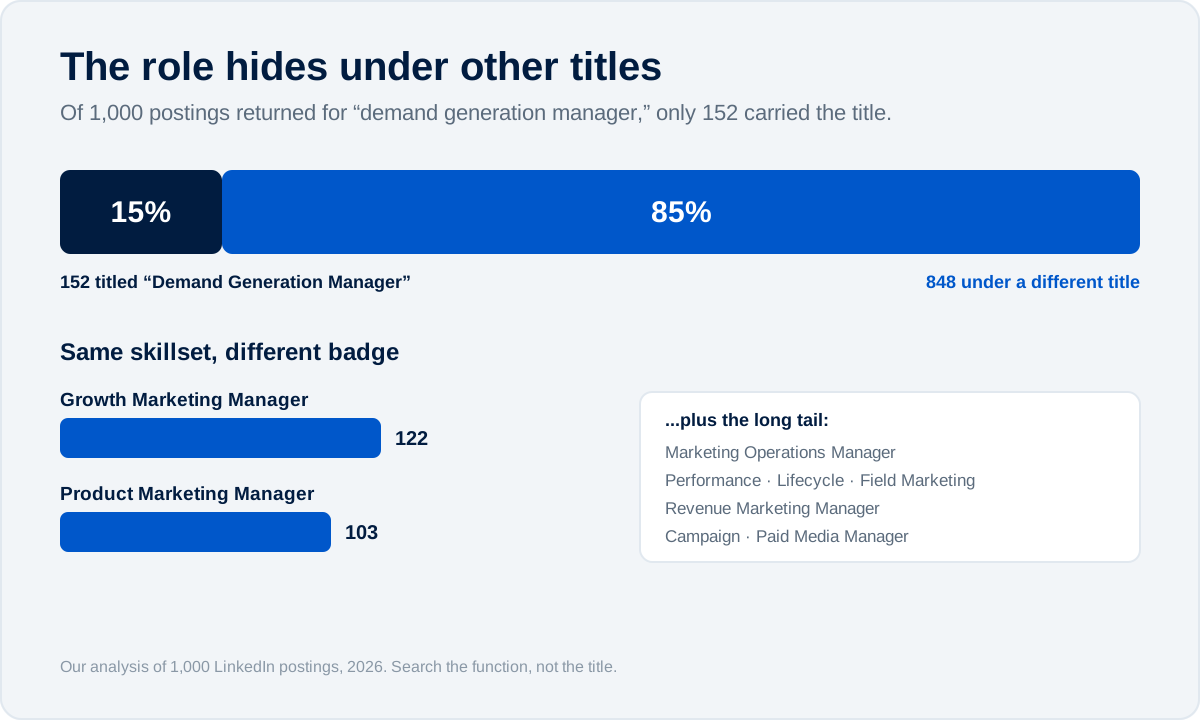
Run the titles and the role fragments into a dozen adjacent labels. Growth Marketing Manager showed up in 122 postings. Product Marketing Manager in 103. Then a long tail that all wants the same core skillset: Marketing Manager, Marketing Operations Manager, Performance Marketing Manager, Lifecycle Marketing Manager, Field Marketing Manager, Revenue Marketing Manager, Campaign Manager, Paid Media Manager. Same job to be done — generate and convert pipeline — wearing a different badge depending on how the company is organized.
Practitioners feel this even when they can't see the data behind it. "Our days look very different despite having similar titles and roles," one manager noted, comparing his enterprise-SaaS work to a friend's at a mobile app company. The title is a weak signal; the company's stage, model, and go-to-market motion are the strong ones.
The practical upshot is simple and most career guides miss it entirely: if you only search "demand generation manager," you're seeing a fraction of the roles you're qualified for. Search the function, not the label. Set alerts for growth, lifecycle, revenue, and performance marketing manager roles too, then read the responsibilities rather than the title — the pipeline number gives the real job away every time.
What it actually pays in 2026
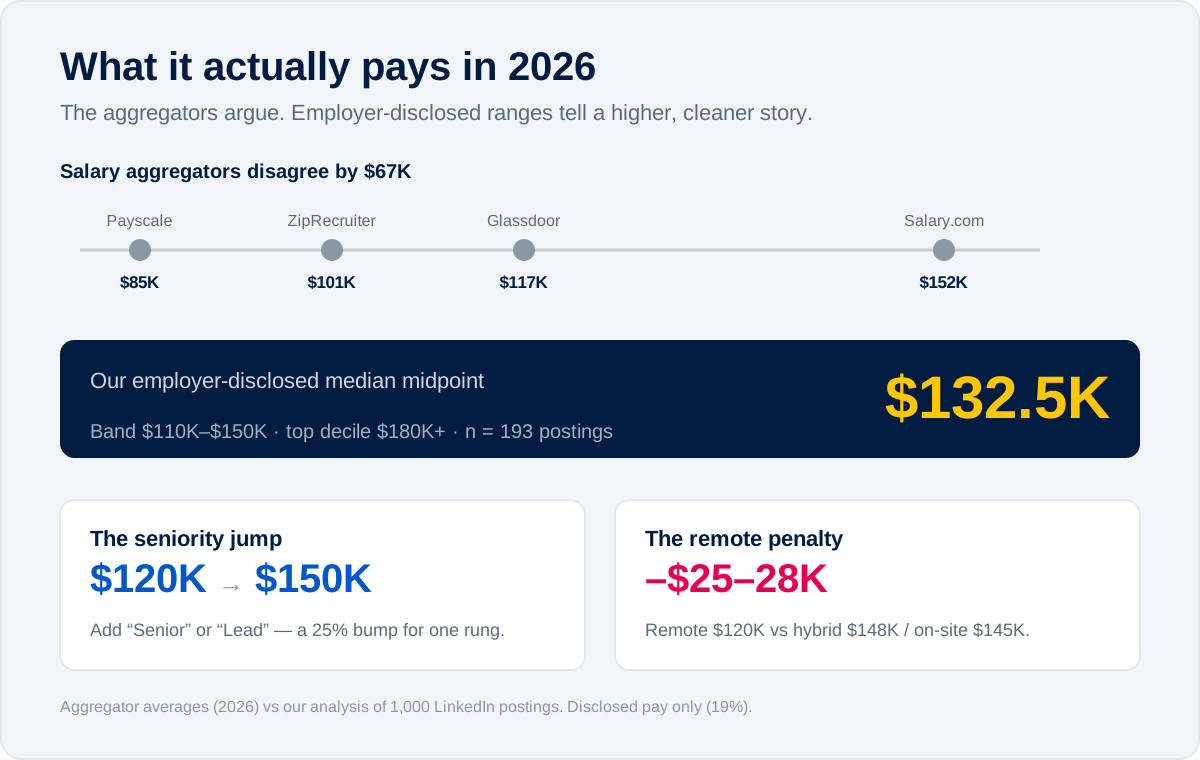
Type "demand generation manager salary" into Google and the box at the top will tell you the average is $101,463. Click around and the number won't hold still. Glassdoor says the average is closer to $116,600. Payscale puts the base under $85,000. Salary.com lands all the way up around $152,000. That's a $67,000 spread for the same job title — which tells you these self-reported aggregators are arguing, not measuring, even though published averages often land around $84,876 and commonly show manager pay bands in the $65,000–$90,000 range.
So we used the cleaner signal: what employers themselves disclosed. Of our 1,000 postings, 193 listed pay (19% — more on why that's low in a second), and among the full-time, salaried US roles the median compensation midpoint was $132,500, with most bands running $110,000 to $150,000. The top decile cleared $180,000. That sits well above the headline aggregator figures, for a reason worth understanding: employer-disclosed ranges skew current and skew toward the states with pay-transparency laws — California, New York, Washington, Colorado — which also happen to be where the higher-paying tech employers cluster.
Two patterns inside our pay data are more useful than any single average.
The seniority jump is real and steep. Postings with a plain "Manager" title carried a median midpoint of $120,000. Add "Senior" or "Lead" and it jumped to $150,000 — a 25% premium for one rung. Broad market benchmarks usually place a demand generation specialist at $40,000–$55,000, senior manager roles at $85,000–$120,000, and director-level digital marketing positions at $110,000–$160,000, which helps explain why employers offering competitive compensation and comprehensive benefits can still cluster above those published norms. The "demand gen → senior demand gen" move is one of the better-paid single steps in the marketing org.
And the counterintuitive one: remote roles pay less. Fully remote postings had a median midpoint of $120,000, against $148,000 for hybrid and $145,000 for on-site. The remote discount runs roughly $25–28K. Part of that is mix — remote roles draw from a national talent pool and get benchmarked to the national median rather than to San Francisco or New York — but if you're optimizing purely for cash, the data says the highest-paying postings still want you in a building at least part of the week. That's a trade-off worth making with open eyes, not by accident.
Get a FREE Content RevOps Audit
Discover exactly where your content-to-pipeline gaps are and get a personalized action plan to fix them.
What employers actually require now for marketing strategy — and the AI shift nobody priced in
Most role guides give you a generic tool list: "marketing automation, analytics, a CRM." Useful in 2018. We counted what 1,000 real postings in 2026 actually demand, and the stack has a clear shape. Employers also expect hands-on familiarity with marketing automation platforms, and proficiency with marketing automation tools is essential for success.
On the platform side, Salesforce (23%) and HubSpot (21%) dominate, with broader "marketing automation" experience named in 22% of postings. The dedicated automation platforms thin out fast behind them — Marketo at 9%, Pardot at 3%. Account-based marketing tools like 6sense (4%) and Demandbase (2%) are still specialist, not assumed. On the analytics side, Google Analytics / GA4 (12%) leads, and a quietly important 7% of postings ask for SQL — demand generation managers use google ads and analytics platforms to analyze metrics in Google Analytics, apply strong analytical skills when interpreting campaign data, and use those insights to improve campaign performance, often using analytics tools to understand customer behavior and website traffic; the line between "marketer" and "person who can query the data themselves" is becoming a hiring filter. Outreach and Salesloft show up in 10%, reflecting how much demand gen now overlaps the sales-engagement stack.
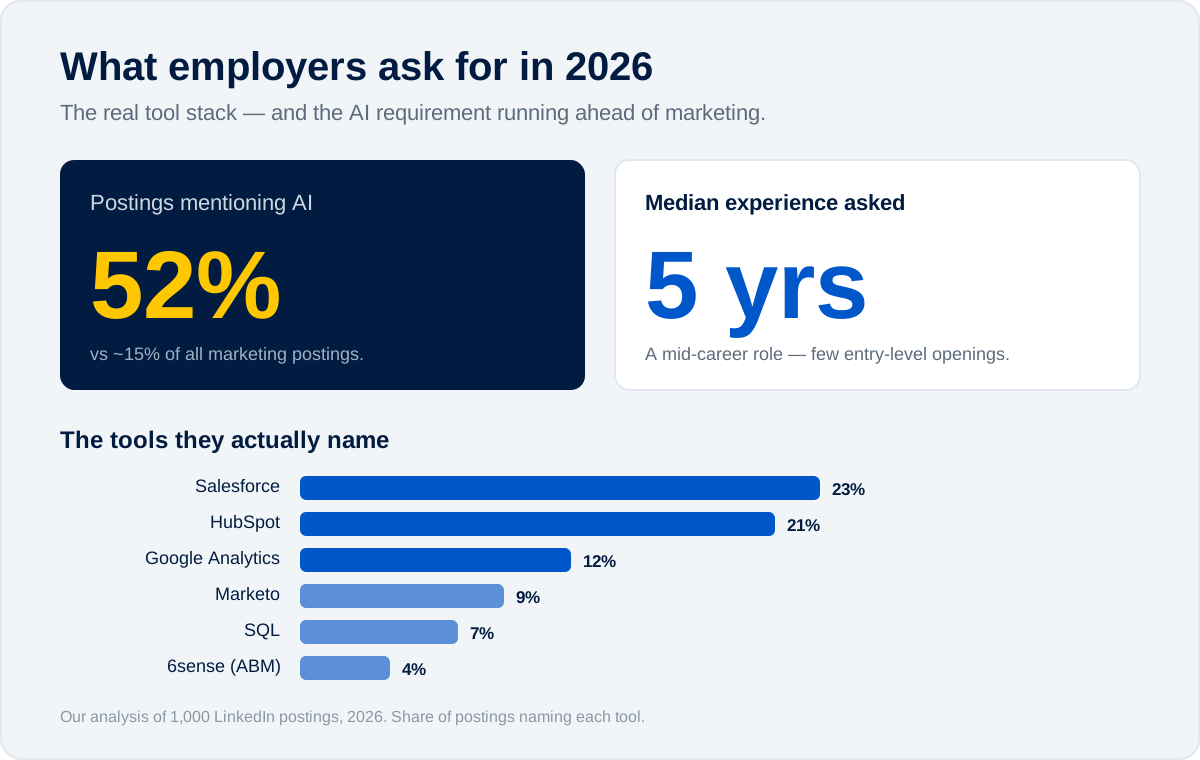
The responsibilities are similarly concrete: pipeline (40%), budget ownership (35%), paid media (30%), lifecycle (27%), A/B testing (21%), attribution (19%), and ABM (18%). These demand generation campaigns and demand generation strategies often combine content marketing with paid search, sit inside broader marketing campaigns, and require proficiency across digital marketing channels including PPC, SEO, and social media. Demand generation managers also analyze sales data and market trends to refine customer segments and market segments, while balancing multiple timelines and budgets across cross-functional work. The experience bar is consistent — the median posting that specified one asked for five years, and very few entry-level openings exist; this is a mid-career role almost everywhere.
But the standout finding is about AI. Across our 1,000 postings, 52% mentioned AI — artificial intelligence, generative tools, or related skills — somewhere in the job description. For context, only about one in seven marketing postings overall reference AI in recent labor-market data — and AI is already one of the fastest-rising, highest-premium skills in the job market at large. Demand generation isn't tracking the marketing average on this; it's running well ahead of it. The role sits where the budget, the tooling, and the measurement pressure all concentrate, so it's absorbing AI faster than the function around it.
This is the gap the older guides can't close, because the top-ranking explainers were written in 2022 and earlier, before the shift. We see the same rewrite at the frontier: in our analysis of 101 marketing roles at leading AI companies — OpenAI, Anthropic, Mistral, xAI, Google DeepMind — the job specs barely resemble the standard demand gen template at all. If you're preparing for this role in 2026, "familiar with AI tools" is no longer a nice-to-have you tuck at the bottom of the résumé. For half the market, it's the job, and it increasingly favors people who can define and report on key metrics, work from campaign data, follow industry trends, and blend data analysis with creative storytelling — with more employers expecting strategic direction tied directly to business objectives.
Is it a good career? The honest market read
Here's the part the career guides skip because it isn't flattering: the demand gen manager market is crowded, and interest in the exact title is cooling.
Crowded first. The median posting in our dataset had 71 applicants, and 42% had crossed 100 by the time we pulled the data. These are not quiet listings you can slip into — they're competitive, and the most attractive ones (remote, recognizable brand) draw the biggest crowds. Only 10–15% of B2B leads convert into paying customers, which raises the cost of weak alignment. Some of the heaviest hirers were exactly who you'd guess: AWS, Amazon, OpenAI, Stripe, TikTok, Google, DoorDash, LinkedIn. Demand gen talent concentrates where the pipeline pressure and the budgets are.
Now the part that needs saying plainly. Search interest in "demand generation manager" as a phrase has fallen sharply — down roughly 56% year over year in our keyword data. Read in isolation, that looks like a dying role. Read against the title-sprawl finding, it's something subtler: the work isn't disappearing — 459 of our 1,000 postings went up in the final week of the pull, so hiring is very much live — but the label is losing ground to "growth," "revenue," and "lifecycle" marketing as companies reorganize around the sales pipeline rather than the channel. Effective demand generation requires sales and marketing alignment. Demand gen managers work closely with sales and marketing teams to keep messaging consistent across campaigns and handoff points, ensuring marketing and sales teams stay aligned as prospects move through the buyer's journey. Aligned organizations have 67% higher conversion rates and can increase revenue by over 209%, while misalignment costs businesses over $1 trillion annually because sales teams waste time on unproductive leads instead of qualified leads. The function is healthy because demand gen managers support pipeline growth by aligning marketing efforts with sales efforts across the buyer's journey. The specific badge is being quietly replaced. That's good news if you're flexible about titles and a real risk if you're not.
Where are the jobs? Overwhelmingly in software (33% of postings), then advertising services, financial services, and IT. Geographically they cluster in New York (116), California (114), and Texas (70), though 52% were remote-eligible, which widens the field considerably if you're outside the coastal hubs. And the companies hiring span every size — our postings split fairly evenly from sub-50-person startups to 5,000-plus enterprises, with a median employer headcount around 580. This is not a startup-only role.
So: good career? Yes, if you go in clear-eyed. The pay is strong and the seniority ladder is well-compensated, the skillset travels across industries, and the work is live. But it's competitive, it's mid-career (plan to break in through an adjacent role, not into it cold), and you should attach yourself to the function, not the fading title.
How to break into a demand generation manager role
Almost nobody starts here. Most demand gen managers reach the role after 3–7 years, often after contributing on demand generation teams, and a bachelor’s degree in marketing or business is commonly preferred. The role sits a few years into a marketing career, and the most common paths in are lateral — which the data and the practitioners agree on.
The strongest adjacent backgrounds are sales and marketing operations. A sales manager weighing the jump put it well: with years of pipeline ownership and a stint titled "senior manager, lead generation," demand gen "is not too much of a jump." That instinct is right. The pipeline accountability transfers; what you add is the marketing-channel and tooling fluency, including CRM knowledge for entry-level roles, lead scoring, familiarity with sales processes, and the ability to bridge the gap between creative and sales teams while working across the marketing department, customer success, and multiple stakeholders. The community advice to that poster was specific and matches our requirements data: get hands-on with Google Analytics and HubSpot, learn SEO and paid fundamentals — because demand generation focuses on the top and middle of the funnel while lead generation targets the middle and bottom of the funnel, and 70% of buyers are informed before contacting sales teams — and understand the target audience, customer pain points, and the broader customer journey when creating campaigns for potential customers, then pick up a credential like HubSpot's Inbound Marketing certification to signal it. Those aren't résumé decorations — they map directly onto the tools that showed up most in our 1,000 postings.
Three things will move you from qualified to hired:
Carry a number you can defend. Demand gen is measured on pipeline, so your story has to be quantitative — "developed an integrated campaign that generated X qualified pipeline and cut cost-per-opportunity by Y," with KPIs like cost-per-lead and conversion rates you can define, track, and report. Vague "managed campaigns" language reads as junior. The role wants someone who can prove ROI to a CRO, and your interview answers should sound like that person already; the strongest candidates also demonstrate expertise through content creation and targeted campaigns tied to customer acquisition.
Show the AI fluency. With half the market now naming AI in the job description, demonstrating that you actually use generative tools in your workflow — research, copy iteration, analysis, automation — is fast becoming the difference between two otherwise-equal candidates. Successful managers also need strong organizational, written, and verbal communication skills, plus a proven track record executing multichannel programs that raise brand awareness, generate leads, and nurture prospects. This is the single highest-leverage thing you can add to your profile in 2026.
Search the function, not the title. Loop back to where we started: most of the roles you want aren't called "demand generation manager." Set your alerts for growth, lifecycle, revenue, and performance marketing manager openings too, read the responsibilities for the pipeline number, and apply to the job rather than the label; these skills also transfer to integrated campaigns and expansion into new markets. The candidates who understand that the role is mislabeled are already searching a market three or four times larger than everyone else competing on the literal phrase.
That's the whole reframe, really. "Demand generation manager" isn't a tidy job with a fixed definition — it's a function with a dozen names, a real pay premium, a fast-moving skill requirement, and a crowded front door. Know what it actually pays, what employers actually ask for, and where it actually hides, and you're already ahead of most of the people you're competing against; if you're searching by function, that also helps you spot roles where account-based marketing focuses on high-value target accounts.
Want demand gen that's measured on pipeline, not activity?
Content RevOps builds the demand-creation-to-capture system a great demand generation manager runs — content, brand, and automation working as one, closed-loop to pipeline.
Frequently Asked Questions
About the Author

Founder & CEO, Content RevOps
Stefan Kalpachev is the founder and CEO of Content RevOps, where he helps B2B SaaS companies transform their content into predictable pipeline. With a background in content marketing and revenue operations, Stefan has developed a unique methodology that bridges the gap between content creation and revenue generation.
Connect on LinkedIn