The Demand Generation Framework Most Teams Build Backwards
Think your demand gen problem is the content? It's usually the foundation.
Book a CallSearch "demand generation framework" and the advice is remarkably consistent. Define your audience. Create helpful content. Distribute it on the channels your buyers use. Nurture the leads. Measure and optimise. It is sensible, it is repeated everywhere, and it quietly skips the part that actually decides whether any of it works.
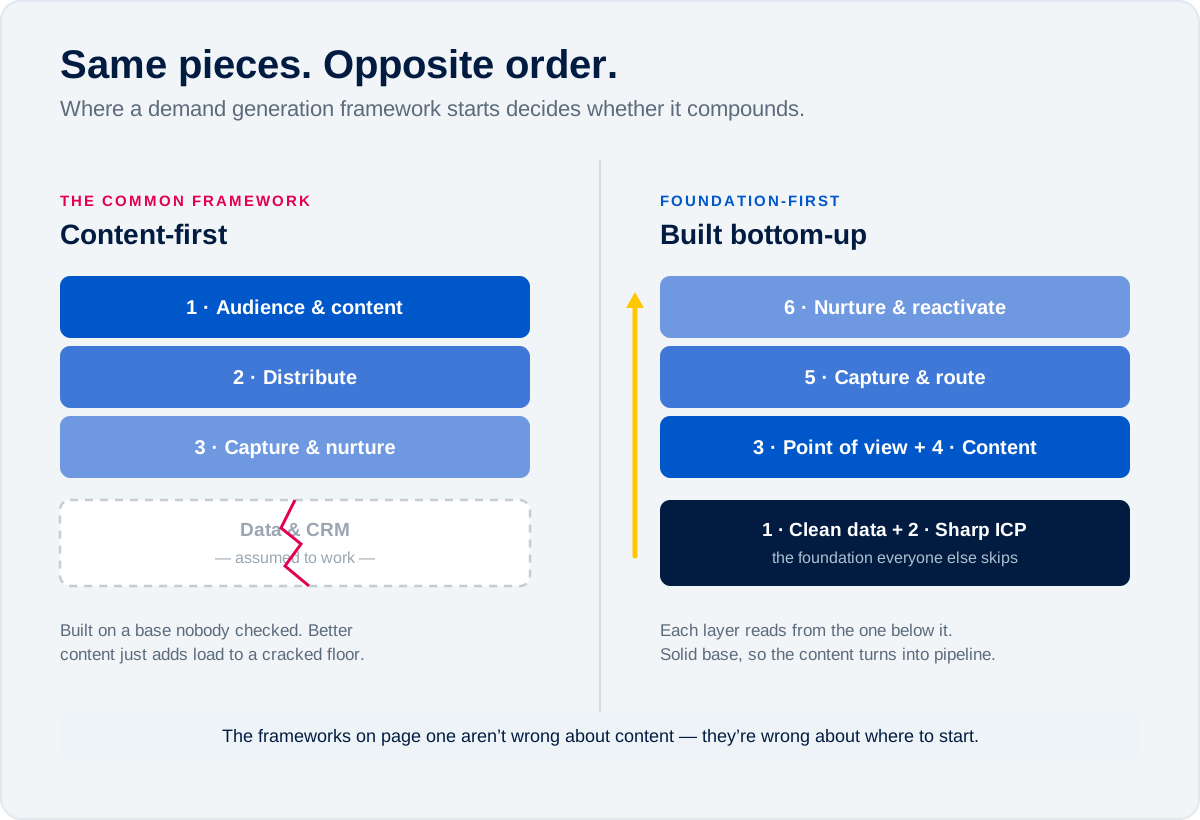
Every one of those frameworks starts at the content and audience layer. They assume the layer underneath — your data, your CRM, your definition of who you're even trying to reach — is already clean and working. For most teams, it isn't. And when the foundation is broken, better content doesn't fix the pipeline. It just produces more activity on top of a system that can't tell a good-fit buyer from a dead email address.
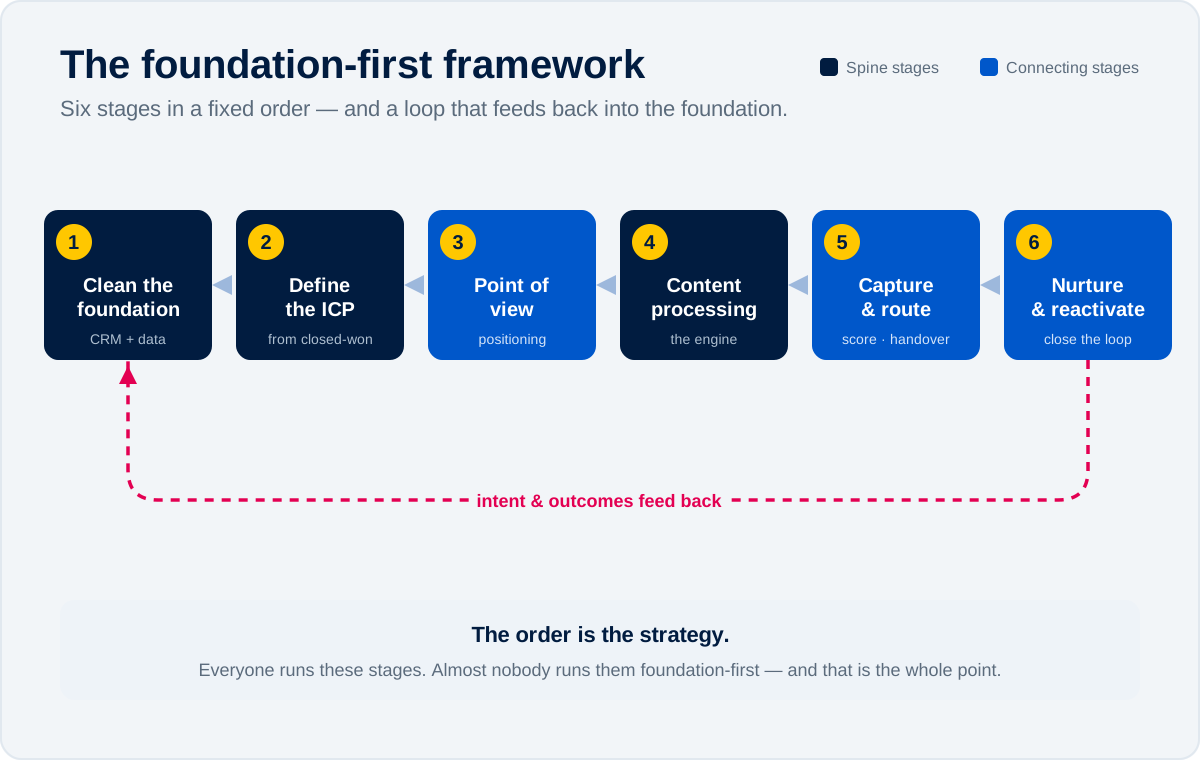
A demand generation framework that compounds is built in the opposite order. You start one layer below where everyone else begins: with the data and the operating model. Clean the foundation, define who you're targeting from what's actually closing, and only then build the content engine on top. This is the foundation-first framework we run at Content RevOps, and it is the order most teams have backwards.
Why most demand generation strategy frameworks fail before stage one
The content-first framework has an unspoken prerequisite: that your systems can act on the demand you create. In a broader demand generation strategy, this matters because demand generation focuses on building awareness and interest before any handoff happens. That's also where demand generation differ from a narrower lead generation strategy: generate interest, and a clean record lands in the CRM, gets scored against a real ICP, and routes to a rep who follows up. That chain is where demand generation either turns into pipeline or evaporates. And at most companies, every link in it is weaker than the marketing sitting on top.
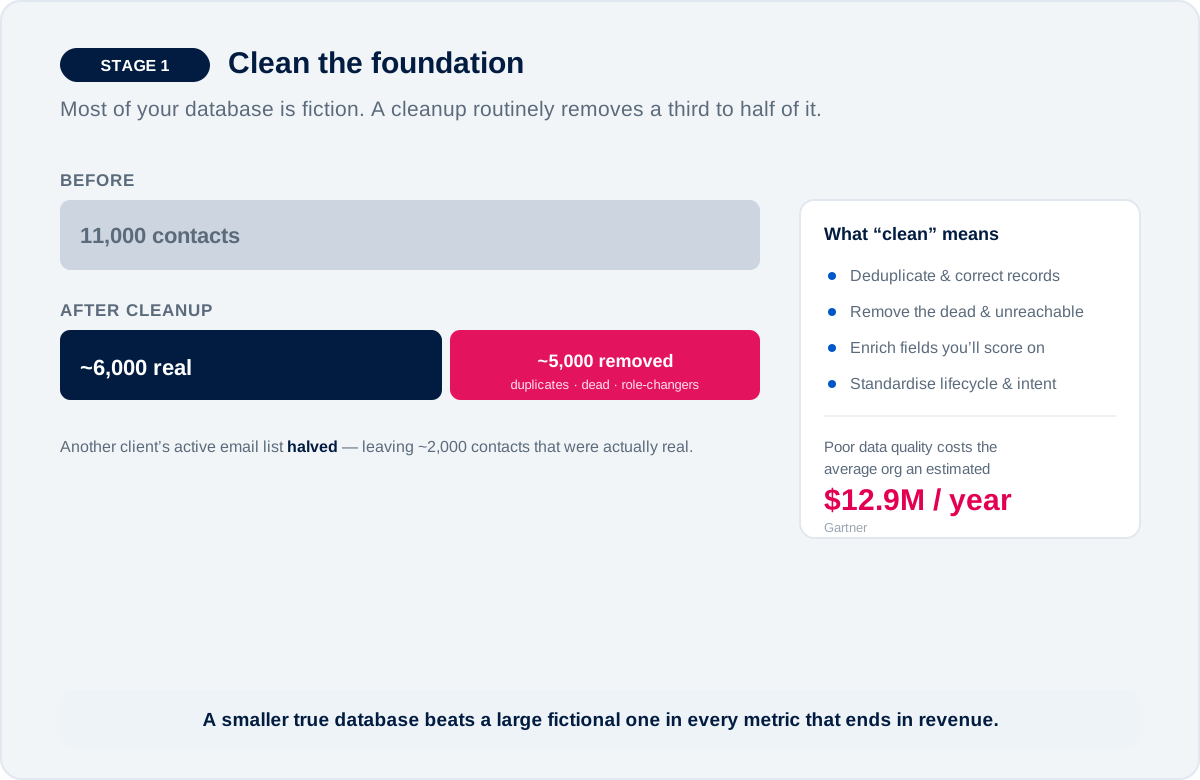
Start with the data, because everything downstream inherits its quality. Gartner estimates that poor data quality costs the average organisation $12.9 million a year. MIT Sloan, drawing on work by Thomas Redman, puts the cost of bad data at 15 to 25% of revenue for most companies. These aren't abstractions when you look inside a typical CRM. In Validity's survey of more than 1,200 CRM users, 91% reported that the data they request is often or sometimes inaccurate, and 44% estimated their company loses over 10% of annual revenue to poor-quality CRM data. The same respondents said bad data had already delayed or killed marketing campaigns nearly half the time. Run a brilliant demand programme into that, and a meaningful share of the demand never reaches anyone who can act on it.
It gets worse over time on its own. Dun & Bradstreet, auditing 223 million B2B records, found more than 70% had gaps or inaccuracies. People change jobs, companies get acquired, domains switch — and a database that looked fine a year ago is quietly rotting while you point campaigns at it. The academic literature has been blunt about the consequence: a review of data quality in CRM concludes that the entire return on a CRM system is gated by the quality of the data inside it. Garbage in isn't a cliché here; it's the mechanism.
Then there's the reason all of this stays invisible. Marketing is measured on leads and sales is measured on closed deals, so when pipeline underperforms, the instinct is to blame the content or the channel — never the plumbing. The deeper problem is that sales and marketing are working from different measures of success, even though lead generation only works when the underlying system is shared. The fix that gets proposed is always more: more posts, more campaigns, more spend. Foundation-first inverts the diagnosis. Before you ask whether your content is good enough, ask whether your system can even use the demand it creates.
Stage 1: Clean the foundation (the step everyone skips)
The first stage of the framework is the one no competing framework includes: get the data and the operating model into a state where demand generation can actually run on it. This is unglamorous, and it is exactly why it's a moat — almost nobody does it before they start. In practice, the demand generation process only works when the underlying system is consistent enough to support it.
Concretely, cleaning the foundation means deduplicating and correcting records, removing the dead and the unreachable, enriching what's left with the firmographic and behavioural fields you'll need for a lead scoring system, and standardising how lifecycle stages and intent are recorded so the system speaks one language. It is closer to plumbing than to marketing, and it's why we run CRM cleanup as a distinct piece of work rather than a footnote. That same groundwork is what lets marketing automation and automation tools track behaviour properly, route qualified leads reliably, and gives marketing automation tools clean inputs instead of noise.
Teams consistently underestimate how much of their database is fiction. In our own client work, a cleanup routinely removes somewhere between a third and half of a list. One company's CRM went from roughly 11,000 contacts to about 6,000 once the duplicates, role-changers and undeliverables came out. Another's active email list halved, leaving around 2,000 contacts that were actually real. That sounds like loss, and it feels like loss to whoever built the list. It's the opposite. Every dead record you keep is a record your scoring model mis-weights, your reporting inflates, and your nurture wastes sends on. A smaller true database beats a large fictional one in every metric that ends in revenue.
The point of stage one isn't tidiness for its own sake. It's that ICP scoring, lead routing and nurture — every stage that follows — reads from this layer. If it's wrong here, it's wrong everywhere, and no amount of downstream cleverness recovers it. Fix it first, once, and the rest of the framework has something solid to stand on.
Stage 2: Define the ideal customer profile (ICP) from what's actually closing
With a database you can trust, you can define who you're targeting — not from a workshop whiteboard, but as the first operational step in the demand generation process, using the evidence already sitting in your CRM. Most demand generation frameworks treat the ideal customer profile as a persona exercise. Foundation-first treats it as an analysis of your own closed-won data: which accounts actually bought, stuck around, and were worth having.
The discipline pays off in numbers that are hard to ignore. Research from TOPO (now part of Forrester) found that organisations with a strong, well-defined ICP achieved 68% higher account win rates than those without one. The reason is simply focus: when marketing and sales chase the same narrow set of high-fit accounts instead of spreading effort across everyone who fills in a form, every downstream conversion rate improves. McKinsey's customer-analytics work points the same way — companies that actually use customer data to target are far more likely to outperform peers on acquisition. And the academic case for segmentation as a performance lever is long-standing; recent work on optimal market segmentation formalises what practitioners feel intuitively — that serving a sharply defined segment beats serving everyone a little.
Our own way of choosing the right ICP starts with identifying target audiences through closed-won analysis rather than guesswork. That means target audience identification based on who has already converted, stayed, and expanded. We build buyer personas from those patterns, then refine them into detailed buyer personas that capture role, context, and urgency. This helps us understand pain points before we write messaging, and it keeps the target audience tied to evidence instead of opinion. We list every plausible customer type, then score each on five factors: market size, the slice we can realistically win, lifetime value, urgency of need, and how easily we can reach them. The winner isn't the biggest market — it's the one where need, value and reachability line up. Then we write a disqualifier list, because deciding who you won't target is what stops a demand engine from drifting back into high-volume, low-fit noise. In ABM terms, this is also how we separate broad-fit companies from high value accounts worth personalised effort.
This is also where the clean foundation earns its keep. Targeting precision is only as good as the data you filter on. In one engagement we took a list of 5,000 LinkedIn sales-leader contacts and narrowed it to roughly 1,400 that genuinely fit — a cut you can only make confidently when the underlying records are accurate. A sharp ICP run against a dirty database is just a confident way of being wrong.
One more reason to get this right before you make any content: the people you're selling to don't buy the way the old funnel assumes. Gartner's research puts a typical B2B purchase in the hands of six to ten decision-makers, each arriving with their own independently gathered research. You're not persuading a buyer; you're arming a committee. If you don't know precisely who that committee is, you can't possibly make content that speaks to it.
Stage 3: Turn the ICP into a point of view
There's a short, load-bearing step between identifying target audiences from closed-won data and producing anything for them: deciding what you actually stand for. We treat this as moving from research to positioning. Go back through the customer and sales conversations, isolate the pains and phrases that keep recurring, and push each one past its surface to the thing underneath. Then state plainly what the market typically does, what you do differently, and why that difference matters, because this is also where demand generation starts establishing brand authority. That's your differentiated point of view, and it's what stops the next stage from producing competent content that says nothing. If this part is vague, everything built on it will be too.
Get a FREE Content RevOps Audit
Discover exactly where your content-to-pipeline gaps are and get a personalized action plan to fix them.
Stage 4: Content strategy processing, not content production
Now — and only now — content. The reason it sits at stage four rather than stage one is that content built on a clean foundation, a sharp ICP and a real point of view does a completely different job than content cranked out to fill a calendar. The framing matters: the goal isn't content production, it's content processing — running a defined input through a repeatable system so every asset has a job and a place, rather than generating one-off pieces and hoping.
Most companies are not doing this, and our own data shows how stark the gap is. Across a cross-industry analysis of 13,248 websites in nine industries, only about a quarter showed active content marketing and nearly half had nothing meaningful at all. Where content did exist, it skewed badly toward the top of the funnel — roughly 43% awareness-stage versus only about 19% decision-stage — and genuine conversion paths existed on as few as 3 to 11% of sites. The lesson isn't "make more content." It's that volume without a system produces a pile of awareness blog posts that dead-end, while the assets that actually move a deal go missing.
The system we use to avoid that is a five-level planning stack, built top-down so each layer has something real to support. It starts with a theme — one validated buyer problem the programme will revolve around for a few months, not a loose topic. Then raw assets: the interviews, research and first-hand evidence that give the work substance and stop it being generic. Then one substantial core asset — a guide, benchmark or tool good enough that everything else can point back to it. Then interactive assets like a webinar, calculator or template that turn passive reading into a next step. And finally supporting assets — the articles, emails and posts that distribute and reinforce the message. That top-down structure is what turns content creation into a system instead of a scramble, and it gives you a solid content strategy tied to real buying problems. It also helps map assets to the buyer's journey, so each piece supports a specific decision rather than filling space. When teams start at the bottom with lightweight content first, the output stays busy but disconnected. Start at the theme and build down, and the work compounds instead of resetting every month.
Two things make this a processing system rather than a content treadmill. The first is repurposing as default, not afterthought: a single core asset is designed from the outset to atomise into blog posts, a webinar, email sequences, sales one-pagers and social posts, so a few anchor pieces feed every channel. In practice, that means using inbound strategies to turn ebooks, webinars and blog posts into connected assets rather than isolated campaigns. The second is that distribution is built in before anything ships — we treat distribution as part of the product, defining where each asset will be seen and what happens next across multiple channels, because a guide nobody sees is unfinished. That includes search engine optimization for organic discovery, social media platforms for reach and response, and the rest of inbound marketing that builds engagement before sales gets involved. This is also how you serve that six-to-ten-person buying committee that spends only about 17% of its time with any vendor: you can't out-meeting them, so the content has to do the educating while you're not in the room, and a differentiated point of view stops it from saying nothing while establishing brand authority.
Stage 5: Capture, score and route on real signals
Content creates interest. The capture layer decides whether that interest becomes something sales can act on, or just traffic you congratulate yourself on. This is the middle layer between content and sales, and it's where a lot of otherwise-good demand generation quietly leaks from the demand generation funnel.
The goal isn't to force everyone toward a demo. It's to make buying movement visible — to give people stage-appropriate ways to identify themselves and signal intent across the sales funnel, and to capture the signals that matter rather than every interaction equally. A resource download, a webinar registration and a pricing-page visit are not the same thing, and a system that treats them as equal hands sales a pile of undifferentiated noise.
So you score on two axes kept deliberately simple: fit (does this match the ICP from stage two) and behaviour (timeline, high-intent actions, recency). Add negative scoring to filter out students, competitors and unsupported regions. Set one clear threshold for marketing qualified leads, another for sales qualified leads, and a higher fast-lane threshold for the rare leads worth immediate outreach. Then route — and routing speed is not a detail. The classic Harvard Business Review analysis of online leads found that contacting a lead within five minutes rather than thirty made reps 21 times more likely to qualify it. Most leads don't get anything like that, which is one reason the conversion maths is so brutal: Implisit's analysis of aggregated Salesforce pipeline data found only about 13% of leads ever become opportunities. A clean foundationand a sharp ICP are what let you improve conversion rates, move the sales process faster, and not clog the sales pipeline with the wrong people.
The other half of routing is what you hand over. A name and an email is not a handover; it's a guess wrapped in a CRM record. We aim for a handover that gives sales real context: who the person is, what they engaged with, what they're likely interested in, and why now might matter for sales teams. The reason is partly trust — reps quietly ignore leads they can't see the reasoning behind — and partly that the academic work on the sales–marketing interface is clear that collaboration between the two functions, not just coexistence, is what improves business performance. Foundation-first makes that collaboration concrete: both sides work from the same clean data and the same definition of "ready."
Stage 6: Nurture, reactivate and close the loop
Most of the people who engage with your content are not ready to buy, and that's normal in a considered B2B purchase. 6sense's research on real buyers found that 81% had already settled on a vendor before they ever spoke to sales — which means the work of winning happens long before the hand goes up, and the capture layer determines whether that interest becomes something sales teams can actually act on. Nurture is how you stay useful in that long gap instead of disappearing after the first touch.
Done properly, nurture isn't "sending emails." It's a structured way of continuing the journey across the entire customer journey: keeping the relationship alive, continuing to educate, and building long term relationships while surfacing intent over time so you can see who's warming. We segment it by what someone has done and how engaged they are — webinar attendees, resource downloaders, repeat visitors, and the older, high-fit but low-engagement accounts already sitting in the CRM. That last group is the quiet upside of stage one: a clean, enriched database is a reactivation asset, not just a sending list. The contacts you cleaned and kept are people you can usefully re-engage when timing changes.
And the loop closes back where it started. The intent and outcome data you capture here — what created real sales conversations versus noise, which accounts converted into paying customers, which went cold — feeds back into the foundation, sharpening lead quality and the key metrics you use to judge what works. That's what makes it a system rather than a campaign, with key performance indicators that tie marketing and sales efforts to outcomes. It also pays a compounding dividend: aligning the revenue engine this way is what Forrester associates with companies that grow 19% faster and are 15% more profitable than their unaligned peers, especially when marketing and sales teams stay aligned around shared follow-up. Misfire on the basics and the cost shows up on the buyer's side too — Gartner found 73% of B2B buyers actively avoid suppliers whose outreach is irrelevant to them, which is exactly what a dirty database and a fuzzy ICP guarantee.
The order is the strategy
None of these six stages is exotic on its own. Plenty of teams clean data, define an ICP, make content, route leads and nurture. What almost nobody does is run them in this order — foundation first, content fourth — and the order is the whole point across the entire customer journey. Build content on a broken foundation and you get expensive activity. Build it on a clean database and a sharp ICP, with a capture-and-route layer that sales trusts, and the same content turns into pipeline that compounds.
The frameworks on the first page of Google aren't wrong about content. They're wrong about where to start. If your demand generation isn't producing the pipeline the activity suggests it should, the problem is rarely the content you can see. It's the foundation you can't. That sequencing is what makes a successful demand generation strategy repeatable, and an effective demand generation framework depends on the same discipline, lead quality feedback tracked against key performance indicators and key metrics, and long term relationships built through coordinated marketing and sales efforts. Start there, because alignment between marketing and sales teams improves outcomes and helps convert more prospects into paying customers. If you want a hand finding the gaps, that's exactly what our demand generation work is built to do — or read our companion guide on building a demand generation engine from scratch for the week-by-week version.
Let's pressure-test your CRM data, ICP, and lead routing before you produce another asset.
Is your demand generation framework built on a foundation that can actually use the demand? Subheading: We clean the data, sharpen the ICP from what's closing, and wire content to pipeline — foundation-first, not content-first.
Frequently Asked Questions
About the Author

Founder & CEO, Content RevOps
Stefan Kalpachev is the founder and CEO of Content RevOps, where he helps B2B SaaS companies transform their content into predictable pipeline. With a background in content marketing and revenue operations, Stefan has developed a unique methodology that bridges the gap between content creation and revenue generation.
Connect on LinkedInRelated Articles
How the Demand Generation Funnel Works — by the Numbers
Jun 12, 2026
Demand Generation for SaaS: Top 10 Strategies
Jun 11, 2026
Demand Generation Manager: What 1,000 Job Postings Reveal About the Role, Pay & Skills (2026)
Jun 10, 2026