Demand Generation for SaaS: Top 10 Strategies
Building SaaS demand gen that converts — not just attracts? We help B2B SaaS teams fix the funnel architecture where pipeline actually leaks.
Book a CallThere's a line in an r/B2BSaaS thread that most demand-gen guides would rather you didn't read: some marketers think demand gen "is a complete bullshit, just a different name for marketing." It's a fair jab, because the standard advice has earned it. Search "demand generation for SaaS" and you'll get the same article a dozen times — define demand gen versus lead gen, walk the funnel, then list the same six channels: content, SEO, paid, social, email, ABM. None of it is wrong. Almost none of it tells you what's actually broken.
Here's the thing the channel lists miss. Most SaaS demand generation doesn't fail because someone picked the wrong channel. It fails because of a structural defect you can measure — and we did. When we looked at how companies actually build their funnels, the same crack showed up everywhere: teams pour effort into the top of the funnel and build almost nothing where buyers decide. They create demand they can't capture, then wonder why pipeline is thin.
So this isn't another channel checklist. These ten strategies start from what the data says is broken and work backward to what actually moves pipeline — led by our own research, not borrowed slogans.
SaaS demand gen has an architecture problem, not a channel problem
Start with the gap, because it reframes everything that follows.
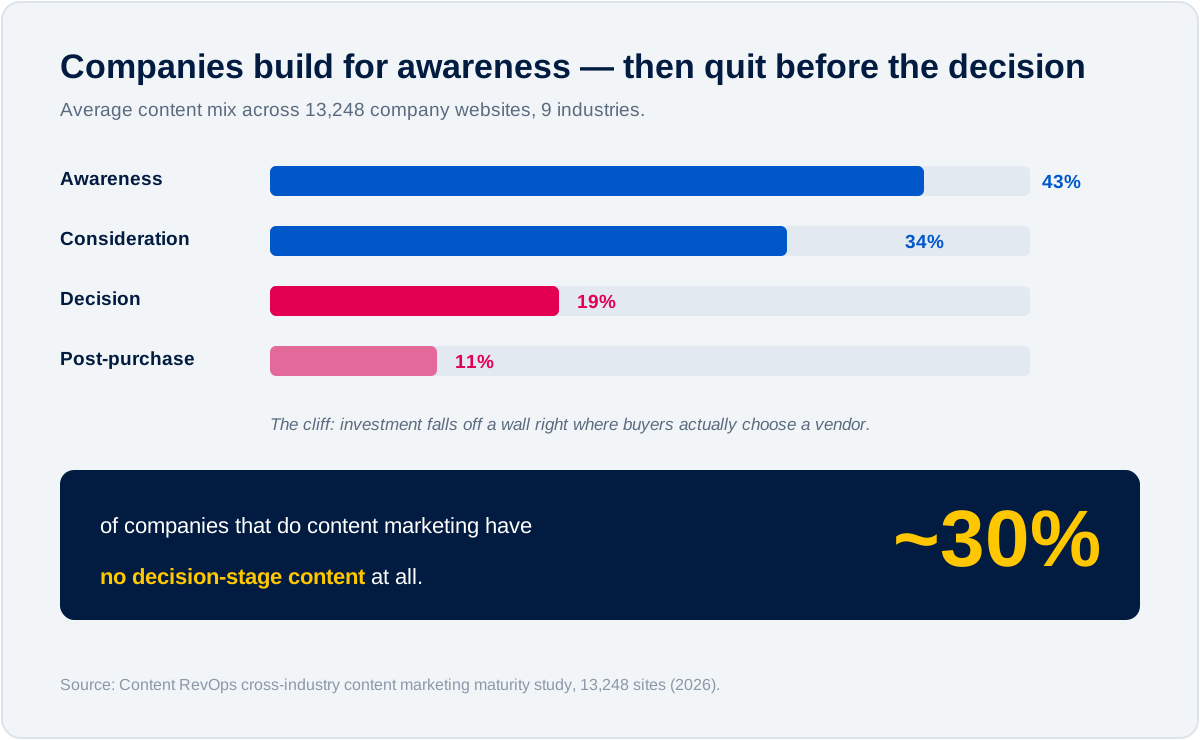
We ran a website-only diagnostic on 13,248 company websites across nine industries — manufacturing, pharma, legal, fintech, life sciences, education, and more. Two numbers stood out. About a quarter of companies run anything that looks like active content marketing, and roughly half show no meaningful content presence at all. That part you might expect. The part that should worry any SaaS marketer is where the companies who do invest put their effort. Averaged across industries, the content mix runs about 43% awareness, 34% consideration, and just 19% decision-stage — with post-purchase a rounding error. Among companies that do content marketing, nearly 30% have no decision-stage content whatsoever.
Read that against how SaaS actually gets bought, with the longer sales cycle typical of saas businesses, and it's almost self-sabotaging. The market is manufacturing awareness it has no mechanism to convert. Demand gets created, drifts to the edge of a decision, and finds nothing there to close it.
That's the lens for the rest of this piece: b2b saas demand generation is a create-and-capture system, and demand generation focuses on both creating awareness and capturing demand across the sales funnel. Get the architecture right and the channels mostly take care of themselves.
Audit your funnel architecture before you add a single channel
The instinct when pipeline is soft is to add a channel — spin up a podcast, test a new ad platform, hire an SDR. It almost never works, because you're pouring more water into a bucket with a hole in the decision stage.
Before you add anything, map your existing content to the buyer's journey and be honest about the split, including how well it serves your target audience at each stage. If your library looks like the industry average — heavy on awareness blog posts, thin on the decision-stage assets a buyer needs to actually choose you — more top-of-funnel volume may reach a broad audience but still fail if the journey is underbuilt. You'll generate more attention that dead-ends in the same place.
The audit is unglamorous and it's the highest-leverage hour you'll spend this quarter. Inventory what you have, tag each piece TOFU/MOFU/BOFU for your target market, and find the cliff. In our data the cliff is almost always the same: plenty of awareness material, a respectable middle, and a decision stage that's either generic or missing. Fix the architecture before you scale the inputs. (Our demand-gen engine guide walks the full build if you're starting from scratch.)
Build the decision-stage content you're losing "no-decision" deals without
Here's the part that should change how you budget. The biggest threat to your pipeline isn't a competitor — it's the buyer doing nothing. Unlike traditional lead generation, which follows traditional marketing approaches focused on immediate capture, this section is about removing the friction that keeps qualified deals from closing.
In the largest study of its kind, Matthew Dixon and Ted McKenna analyzed 2.5 million recorded sales conversations for The JOLT Effect and found that 40% to 60% of qualified, late-stage deals are lost not to a rival but to "no decision."The buyer wanted to move — more than half of those stalled deals involved a customer who genuinely wanted to change — and simply couldn't get over the fear of messing it up. They were paralyzed by risk, not unconvinced of value.
Now lay that next to our finding that ~30% of content-active companies have zero decision-stage content. The single most expensive failure mode in B2B is buyer indecision, and the content specifically designed to defuse it — implementation guides, security and compliance documentation, switching playbooks, honest "is this right for you" pages, total-cost-of-ownership breakdowns — is exactly the content almost nobody builds.
Decision-stage content isn't more persuasion; it's how qualified prospects become paying customers. It's de-risking. Every asset should answer the quiet question a stalled buyer is actually asking: what happens if this goes wrong, and how hard is it to switch? That's the content that closes the deals you're currently losing to silence.
Win the self-serve decision, because buyers are deciding without you
The reason decision-stage content matters so much in SaaS is that successful SaaS demand generation plans must build market awareness and educate buying committees before a rep ever gets involved. Gartner's research on the B2B buying journey found that buyers spend only about 17% of the entire purchase cycle meeting with potential suppliers — and when you split that sliver across every vendor on the shortlist, any single rep gets a rounding error of the buyer's time. By 2026 a majority of B2B buyers say they'd prefer a rep-free buying experience entirely.
If most of the decision happens with no salesperson in the room, your self-serve assets help potential customers move through the buying process without sales involvement. And here the data exposes a wide-open lane. Across our cross-industry study, the tools that let a buyer evaluate and justify a purchase on their own are the rarest content types in existence: ROI calculators appear on roughly 0–2% of sites, and head-to-head comparison pages barely clear that.These assets also create buying intent through targeted, multi-channel marketing that helps decision makers evaluate independently. The exact assets buyers want when they're deciding solo are the ones almost no one publishes.
Build them. An interactive ROI or cost-of-ownership calculator, honest comparison pages (including against the "do nothing" option and the spreadsheet they're using today), a clear pricing page, and a self-guided product tour — as part of a SaaS demand generation strategy within SaaS marketing, with freemium and trial models reducing friction by letting users experience value directly — do more for a self-serve buyer than another awareness blog ever will. You're not trying to be in the room. You're trying to win when you're not.
Engineer conversion paths, not dead-ends
It's possible to do everything right at the top and still leak the demand, because the path from "interested" to "in pipeline" was never built, and many SaaS companies still leave these conversion paths unwired.
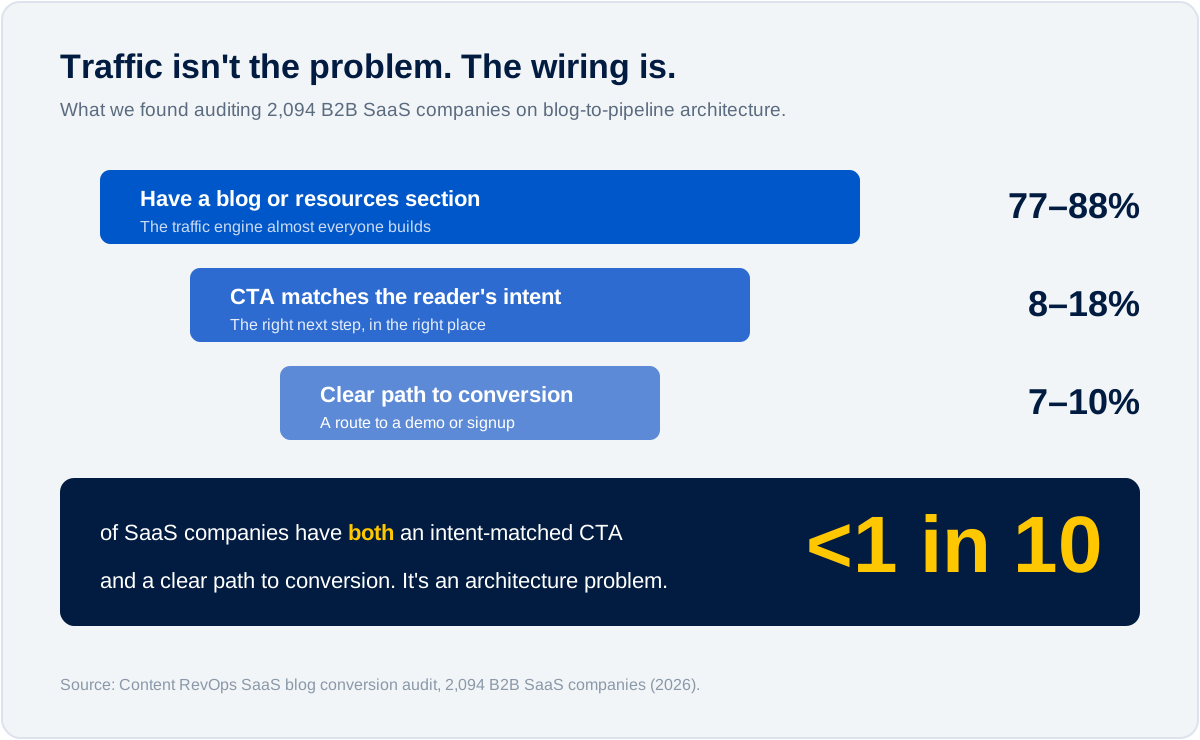
We audited 2,094 B2B SaaS companies specifically on this question — why SaaS blogs get traffic but don't convert. Blogs were nearly universal (present on 77–88% of companies). What was missing was the wiring. Strong alignment between a page's call-to-action and the reader's actual intent showed up on only 8–18% of companies. A clear progression from blog post to conversion existed on just 7–10%. Put bluntly: fewer than one in ten SaaS companies have both a CTA that matches the reader's intent and a path that carries them toward a demo or signup. The rest is content that dead-ends — a reader finishes the post and has nowhere obvious to go.
This is the cheapest pipeline you'll ever find, because the traffic already exists. Map the next logical step for every high-intent page and make the CTA match the moment — a pricing-page visitor and a top-of-funnel blog reader should not see the same "Book a Demo" button. Add contextual, in-line next steps rather than one generic banner. Our conversion-layer methodology goes deep on this, but the principle is simple: every page a buyer can land on should know where that buyer goes next. Once they do, personalized email campaigns can extend lead nurturing while making broader marketing efforts more effective at surfacing marketing qualified leads and other high quality leads.
Publish original data, because it's the only awareness play AI search hasn't eaten
The awareness layer that most SaaS teams over-invest in is being quietly demolished, and the timing matters for how you spend in 2026.
AI Overviews and answer engines now resolve a huge share of the informational queries that used to feed SaaS blogs. Around 60% of Google searches now end without a click, and when an AI Overview appears on an informational query, organic click-through can fall by roughly 60%. Worse for anyone relying on rankings: the overlap between who ranks in the top 10 and who actually gets cited in the AI answer has collapsed — from around three-quarters in mid-2025 to well under half in early 2026. Ranking no longer guarantees you're the source the AI repeats.
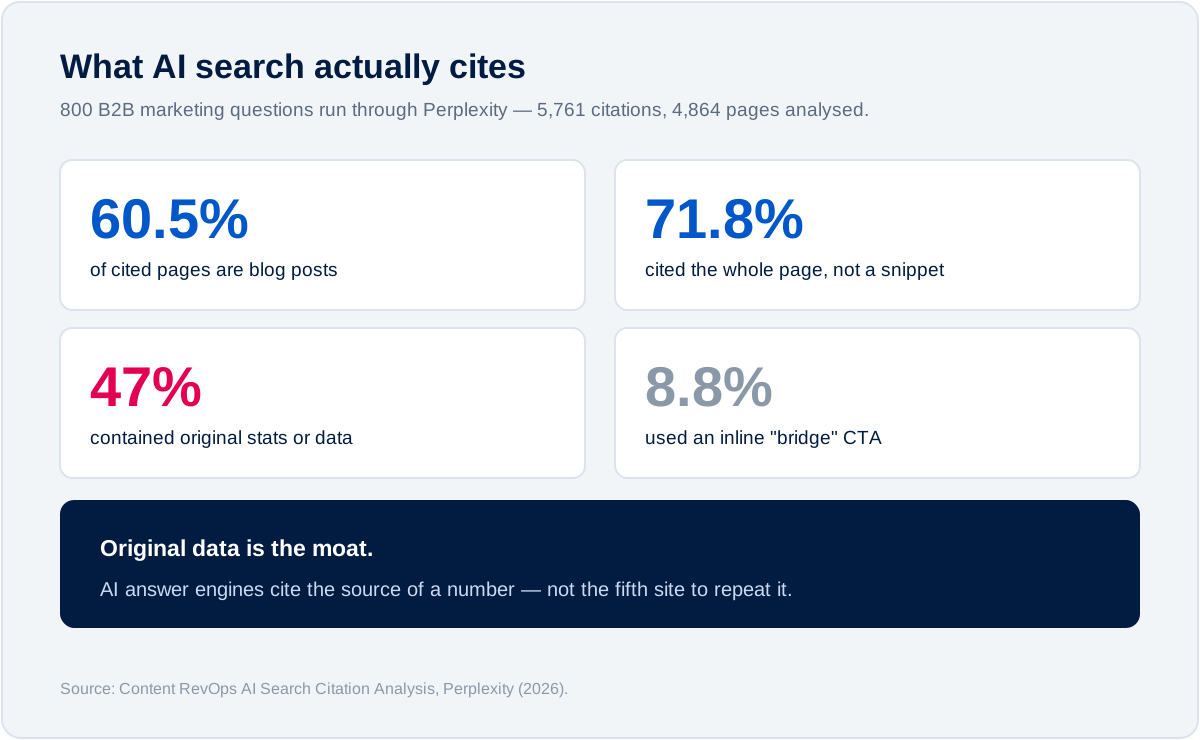
So what does get cited? We ran 800 B2B marketing questions through Perplexity and analyzed 4,864 cited pages. Blog posts made up 60.5% of all cited pages — the format isn't dead, it's just being read by a machine now. And the pages that won citations shared a structural fingerprint: they were long, scannable, and crucially, 47% contained original statistics or proprietary data, which also helps establish brand authority and position you as an industry leader. AI answer engines preferentially cite the source of a number, not the fifth site to repeat it.
That's the unlock. Original research — your usage data, a survey of your customers, a benchmark only you can produce — is simultaneously the strongest EEAT signal, the most-cited asset in AI search, and the one thing a competitor can't copy. Everything in this article that carries weight is a number we generated ourselves. That's not a coincidence; it's the strategy. Even as AI changes click behavior, SEO still matters: optimize content for relevant keywords to improve visibility in search engine results pages, earn more organic traffic and website traffic, build brand awareness, and, through consistent effort, reduce reliance on paid advertising over time.
Get a FREE Content RevOps Audit
Discover exactly where your content-to-pipeline gaps are and get a personalized action plan to fix them.
Kill the generic positioning that makes every other strategy weaker
A quieter pattern in our cross-industry data undermines almost everything else a team does: two-thirds to four-fifths of companies lead with generic, "we help businesses grow" messaging rather than a tightly defined ideal customer. The exceptions are the technical verticals — life sciences and pharma, where the buyer is a scientist and vague claims get ignored.
Generic positioning taxes every channel at once. It makes your awareness content blend in, your ads convert worse, and your decision-stage assets less convincing, because nothing on the page signals "this was built for someone exactly like me." Demand generation is leverage applied to a message; if the message is generic, you're scaling something forgettable.
Pick a narrower ICP than feels comfortable, write to the specific job and the specific pain, and let the specificity do the qualifying. The narrower the message, the louder it lands with the people who matter — and the cheaper every downstream conversion gets.
Match your capture motion to your model — product-led, sales-led, or both
Once demand exists, how you capture it should follow your product, not fashion, while still serving both new acquisition and existing customers. The two motions convert differently and the benchmarks are public.
In a product-led motion, the product is the demo — free trials and freemium do the qualifying. The numbers to plan against: free-to-paid conversion clusters around 9% on average, with freemium converting visitors at a higher rate than opt-in trials, and product-qualified leads converting several times better than a marketing-qualified one. AI can improve this capture motion by automating lead qualification before human follow-up. In a sales-led motion, the demo request is the goal and humans close. Most SaaS companies now run some product-led motion, but the interesting finding is that hybrids win: companies layering sales-assist on top of self-serve hit their net-revenue-retention targets more often than pure-PLG companies, because they put human attention on the accounts with the most expansion potential.
The practical read: don't bolt a heavyweight SDR-and-demo motion onto a $40/month self-serve product, and don't expect a six-figure enterprise deal to close itself through a free trial. The strongest demand generation engines combine thought leadership with product-led growth and account based marketing rather than relying on one motion alone. Data alignment and tracking help marketing teams and sales and marketing teams decide when product-led versus sales-assisted capture is most effective for the sales team. Match the capture mechanism to deal size and buyer behavior, and reserve sales-assist for where it pays, protects customer lifetime, and improves profitability by aligning customer lifetime value with customer acquisition cost to support consistent demand over time, not just one-time conversions.
Turn demand gen into a timing game with intent data
One of the sharper things said in our community research came from a practitioner describing what actually works now: intent signals "turn demand gen from a volume game into a timing game." That's the right frame. You're not trying to reach everyone — you're trying to reach the right account at the moment its circumstances change.
The same operator described layering third-party intent (funding rounds, hiring spikes, leadership changes, technology shifts) onto outbound so the team shows up when an account is moving, not at random. That trigger-based approach also fits account-based marketing, where teams target specific high-value accounts with personalized campaigns, and multi-channel outreach matters because it reinforces the message wherever those accounts are already active across linkedin ads, ppc advertising, retargeting campaigns, and email, with social media engagement helping when those accounts are actively following and responding on those platforms. It also helps demand signals and messaging spread in-market through industry influencers, not just your own channels. It's the difference between spraying a segment and arriving exactly when a trigger event makes the problem urgent. Used well, intent data can reflect customer behavior and sharpen marketing campaigns by telling you when the slow-moving majority of your market quietly steps into a decision — and lets your capture motion meet them there.
A caution worth keeping: intent data points you at timing, it doesn't manufacture interest. It works when there's demand to detect. That's why it sits at number eight and not number one — it amplifies a working create-and-capture system; it doesn't replace one.
Retire the MQL and measure pipeline plus self-reported attribution
You cannot manage a successful demand generation strategy with a metric built for lead capture alone, and the marketing-qualified lead is exactly that metric — increasingly a vanity number. Industry analyses now peg MQL-to-closed-won conversion below 1%, which means a team optimizing for MQL volume is optimizing for activity, not revenue. Paid channels should be judged by pipeline outcomes because PPC campaigns provide immediate visibility, but they can distort priorities when measured only by lead volume.
The deeper problem is that the best demand creation is invisible to your tracking. A buyer reads your post, watches a founder's talk, lurks in a Slack community, then types your name straight into Google six weeks later — and your attribution model credits "direct" or "branded search," not the work that actually created the demand. A practitioner in our research put it perfectly: "the LinkedIn reply you left three weeks ago did more work than the campaign you ran last week." Estimates suggest 30–50% of pipeline originates in channels analytics can't see. Last-touch attribution doesn't just undercount this work; it actively steers budget away from it, which is why even a $5K test can be enough to validate demand generation tactics before you scale.
Two fixes, both cheap, and both aimed at improving and optimizing the overall strategy continuously. Measure the demand-creation loop on leading indicators that move slowly — branded search volume, share of voice, qualified pipeline created — not lead counts. Paid advertising can accelerate demand generation efforts significantly, but only if you evaluate it on meaningful engagement and revenue influence instead of raw form fills. And add one question to your demo and signup forms: "How did you hear about us?" Self-reported attribution is imperfect and it consistently surfaces the dark-funnel channels your software will never catch. (We go further on which metrics to track and which to ignore.)
Align marketing and sales around the buying group, not the lead
The last strategy is the one that quietly determines whether the other nine survive contact with reality: who you're selling to, and whether sales and marketing agree on it. The unit of a SaaS purchase is not a person. Gartner puts the typical B2B buying group at six to ten stakeholders, each arriving with their own information and their own veto.
A lead-centric demand gen program optimizes for the single hand-raiser and ignores the committee behind them — the security reviewer who'll kill the deal, the finance lead who needs the ROI math, the end users who have to actually adopt the thing. That's a recipe for exactly the "no decision" stall from strategy two: one champion, no consensus, deal dies.
So align the two teams around accounts and buying groups rather than individual MQLs. Agree on one definition of a qualified opportunity. Build content for the other members of the committee, not just the champion — the calculator for finance, the security page for IT, the case study for the executive sponsor. When marketing's job is to arm a buying group toward consensus rather than to dump leads over a wall, the friction that wastes most demand gen budgets simply has less to grab onto. (If you're sizing the team to do this, our breakdown of demand-gen roles and costs is a useful starting point.)
The throughline
Nine of these ten strategies come back to the same idea, and it's worth saying plainly because the channel lists never do. SaaS demand generation isn't a contest of tactics — content versus paid, inbound versus outbound. It's a system for creating demand and capturing it, and the capture side is where the data says almost everyone is broken. We build attention we can't convert, skip the decision-stage assets that close deals, and measure the whole thing with a metric that rewards volume over revenue.
Fix the architecture — build for the decision, win the self-serve buyer, engineer the path, publish data worth citing, and measure what actually moves pipeline — and the channels stop being the question. The teams that win in 2026 aren't running more tactics than everyone else. They've just built the part of the funnel everyone else forgot.
Want demand gen that's built where buyers actually decide?
Content RevOps builds the create-and-capture system behind real SaaS pipeline — original-data content, decision-stage assets, and conversion paths wired to revenue.
Frequently Asked Questions
About the Author

Founder & CEO, Content RevOps
Stefan Kalpachev is the founder and CEO of Content RevOps, where he helps B2B SaaS companies transform their content into predictable pipeline. With a background in content marketing and revenue operations, Stefan has developed a unique methodology that bridges the gap between content creation and revenue generation.
Connect on LinkedInRelated Articles
How the Demand Generation Funnel Works — by the Numbers
Jun 12, 2026
Demand Generation Manager: What 1,000 Job Postings Reveal About the Role, Pay & Skills (2026)
Jun 10, 2026
The Demand Generation Framework Most Teams Build Backwards
Jun 9, 2026